



How to Do Business in Turkey in 2026: A Practical Market-Entry Guide
Updated September 2026. Doing business in Turkey is no longer a simple “lower-cost alternative to Europe” story. Turkey (Türkiye) is a large consumer market, a diversified manufacturing base and a trade platform connected to Europe, the Balkans, the Caucasus, Central Asia and the Middle East. At the same time, inflation, exchange-rate volatility, compliance requirements and fast-changing operating costs make preparation far more important than it was a few years ago.
I have worked on market-entry, supplier, manufacturing and international business projects in Turkey and use Izmir as one of my operational bases. The most successful projects I see do not begin with company registration. They begin by validating demand, choosing the right entry model, calculating the real landed and operating cost, and only then deciding how much local structure is actually required.
Turkey Business Snapshot: What Has Changed in 2026?
For a foreign company assessing the Turkish market, these are more useful than generic “low-cost market” claims:
| 2026 reference point | Current figure / rule |
|---|---|
| Population | About 86.1 million (2025 official population) |
| Consumer inflation | 31.51% year-on-year in August 2026 |
| 2026 minimum wage | TRY 33,030 gross / TRY 28,075.50 net per month |
| General corporate income tax | 25% for ordinary corporate income |
| VAT | General rates of 1%, 10% and 20%, depending on the supply |
| Minimum capital – Limited Şirket (Ltd. Şti.) | TRY 50,000 |
| Minimum capital – Anonim Şirket (A.Ş.) | TRY 250,000 |
| EU–Turkey goods trade | More than €217.6 billion in 2025; 42.7% of Turkey’s goods exports went to the EU |
These figures explain the central reality of how to do business in Turkey in 2026: the market remains strategically important, but budgets, pricing and contracts must be built for an environment where nominal costs can change quickly. Official data should therefore be checked again when a project moves from planning to execution.
Official references: TURKSTAT inflation data, Ministry of Labour 2026 minimum wage, Invest in Türkiye Tax Guide and the European Commission’s EU–Türkiye trade overview.
Why Turkey Still Matters for International Companies
Turkey’s advantage is not one single tax rate or salary level. It is the combination of domestic demand, industrial depth and geographic access. Automotive, machinery, appliances, textiles, chemicals, food processing, packaging, defence-related supply chains, software and logistics all have established local ecosystems. For European companies, the market is also unusually integrated with the EU industrial economy.
The EU–Türkiye Customs Union has been in force since 1995 and removes customs duties and quantitative restrictions for industrial goods within its scope. It does not mean that every product moves automatically or that origin, product-safety and conformity requirements disappear. The A.TR movement certificate demonstrates free-circulation status rather than origin, while agricultural products and certain coal and steel products follow different arrangements. This distinction matters when you calculate landed cost or design a Turkey-to-EU supply chain.
For companies considering production or supplier development, see my manufacturing relocation consulting for Turkey and the Balkans. For a broader expansion process, the relevant starting point is International Market Expansion Consulting.
Do Not Start with Company Registration: Choose the Entry Model First
A common foreign-investor mistake is to incorporate a Turkish company before proving that the commercial model works. In many projects, a lower-risk first phase is exporting through a distributor, appointing an agent, testing direct B2B sales, qualifying Turkish suppliers, or running a pilot with local partners. A legal entity becomes valuable when it solves a concrete operational problem: local invoicing, employees, inventory, tenders, local contracts, regulated activities or long-term manufacturing.
The right model may therefore be a Turkish limited company, a joint-stock company, a branch, a liaison office for non-commercial representation, a distributor relationship, a sourcing structure, or an operation inside a free zone. The choice should follow the revenue model and compliance requirements—not the other way around.
Setting Up a Company in Turkey: What Foreign Investors Need to Know
Turkey’s Foreign Direct Investment framework is based on equal treatment: foreign investors can generally establish the same company forms available to Turkish investors, subject to sector-specific restrictions. The most common structures are the Limited Şirket (Ltd. Şti.) and Anonim Şirket (A.Ş.).
As of 2026, the statutory minimum capital is TRY 50,000 for a limited company and TRY 250,000 for a joint-stock company. For an A.Ş., at least one quarter of subscribed cash capital is generally paid before registration and the balance within 24 months. For a limited company, the subscribed capital can be paid within 24 months after registration. Existing companies below the new statutory thresholds must also pay attention to the 31 December 2026 capital-adjustment deadline under the current rules.
Company incorporation is handled through MERSIS and the relevant Trade Registry Directorate. The official investment guide describes the Trade Registry as a one-stop shop and notes that registration can be completed on the same day when documents are in order. In practice, however, registration is only one part of becoming operational: banking, tax administration, beneficial-owner documentation, accounting, sector permits, employment, premises and commercial onboarding can take additional time.
Foreign corporate shareholders should also plan early for apostilles/legalisation, sworn Turkish translations and powers of attorney. See the official Invest in Türkiye company-establishment guide.
Taxes in Turkey in 2026: Use the Correct Rates
For ordinary corporate income, Turkey’s general corporate income tax rate is currently 25%. Certain financial-sector businesses are subject to different rates. VAT is no longer correctly described as “usually 18%”: the generally applied VAT rates are now 1%, 10% and 20%, with 20% being the standard rate for many goods and services. Exporters may also qualify for a reduced corporate-tax treatment on eligible export income under current legislation, but the calculation should be confirmed with a Turkish tax professional for the specific activity.
Taxes should never be modelled in isolation. Withholding taxes, stamp tax, customs, special consumption tax, transfer-pricing rules, payroll charges and treaty relief can materially change the result. This is especially important for cross-border service agreements, royalties, financing and related-party transactions.
For a more detailed discussion of taxes, payroll and incentives, see my 2026 interview on taxes, labour costs and incentives in Turkey.
2026 Labour Costs: A Better Way to Budget Employees
The 2026 national minimum wage is TRY 33,030 gross and TRY 28,075.50 net per month. The official Ministry of Labour calculation shows a total monthly employer cost of approximately TRY 39,223.13 in manufacturing where the five-point social-security premium reduction applies, TRY 40,214.03 in other sectors with the two-point reduction, and TRY 40,874.63 without the premium reduction.
This is a much more useful benchmark than applying a generic percentage to salary. For engineers, export managers, software specialists, finance staff and senior commercial roles, the legal minimum wage is only a floor; market salaries can be substantially higher. A realistic hiring model should therefore include gross salary, employer SGK and unemployment contributions, benefits, meal/transport allowances where applicable, severance exposure, recruitment cost and expected salary revision during the year.
Free Zones in Turkey: Valuable, but Not a Blanket “Zero-Tax” Solution
Free zones can be highly attractive for export-oriented manufacturing, assembly, logistics and selected technology activities, but the incentives are conditional. The current Ministry of Trade guidance states that earnings of manufacturers from goods produced in free zones and sold abroad or into free zones can benefit from corporate/income-tax exemption under the applicable rules. Wage income of employees of qualifying manufacturers can be exempt from income tax when at least 85% of the FOB value of production is exported. Certain transactions also receive stamp-duty, property-tax, VAT or customs advantages.
That is materially different from saying that every company inside a free zone automatically pays 0% corporate tax or 0% VAT. The activity, operating licence, production status, destination of the goods and timing of the licence all matter. The Ministry of Trade’s 2026 Free Zone advantages guidance should be checked against the specific project.
In Izmir, the Aegean Free Zone operated by ESBAŞ in Gaziemir is particularly relevant to manufacturing and export projects. This is distinct from simply referring to “Izmir Free Zone ESBAŞ”; the exact zone and operating model matter when assessing incentives, premises and licensing.
Customs, Product Compliance and the EU Connection
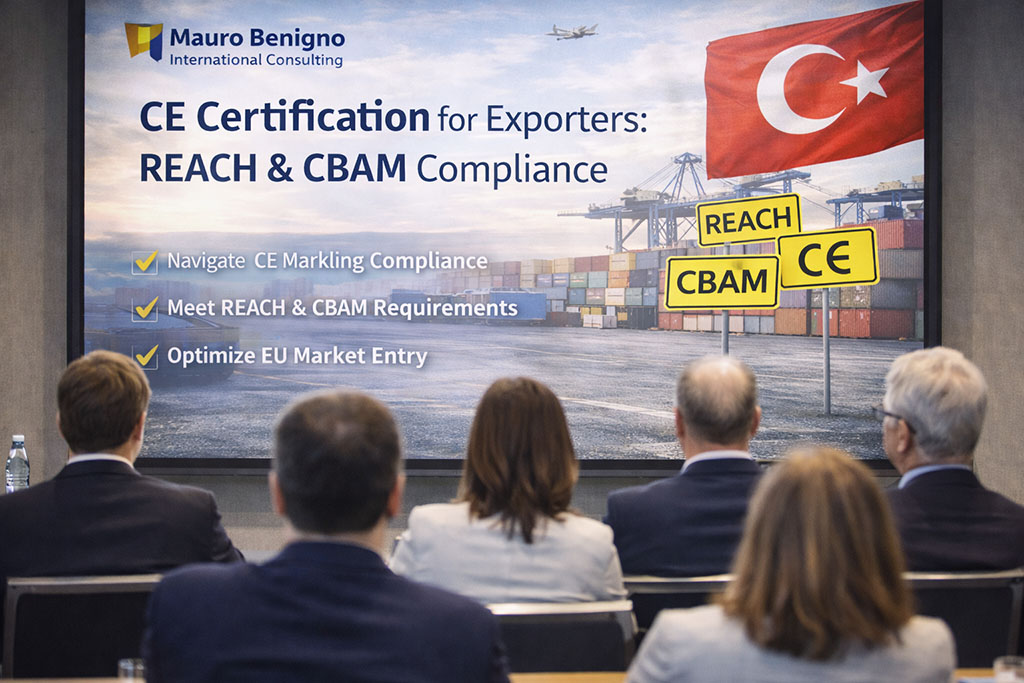
Turkey’s industrial integration with the EU is a major advantage, but companies should not confuse customs preference with regulatory clearance. Depending on the product, import controls can involve the Ministry of Trade, Turkish Standards Institution (TSE), product-safety communiqués, CE-related technical legislation, testing, labelling, importer responsibilities or digital control systems. In 2026, product-specific import inspection communiqués continue to apply across multiple industrial categories.
Before quoting a Turkish customer or relocating a supply chain, map the HS code, customs treatment, origin/free-circulation status, required certificates, product standard and importer-of-record responsibility. This prevents a common problem: a commercially attractive price that becomes uncompetitive after customs, testing, storage or clearance delays. For regulated products, see my certification and compliance consulting and Import–Export Advisory for EU, Turkey & CIS.
Inflation and Currency Risk: The Part of Doing Business in Turkey You Must Model
Turkey’s inflation rate has fallen substantially from earlier peaks, but it is still too high to treat annual budgets as static. TURKSTAT reported annual CPI inflation of 31.51% in August 2026, with monthly inflation of 1.84%. That affects payroll expectations, rent renewals, local-service prices, transport, utilities and working capital.
For foreign companies, the practical question is not whether the lira will move in one direction or another. It is whether the commercial model can absorb volatility. I normally look at the currency of revenue, the currency of major inputs, payment terms, inventory exposure and how frequently prices can be revised. Exporters with EUR or USD revenue may have a different risk profile from a company selling locally in TRY while importing equipment or components in foreign currency.
Useful controls include shorter quotation validity, explicit repricing mechanisms, scenario budgets in TRY and EUR/USD, tighter receivables management and a clear policy for supplier currency. Contract language should be reviewed by qualified Turkish legal and tax advisers before implementation.
A Practical 90-Day Turkey Market-Entry Plan
Days 1–30: validate before investing. Define the target segment, interview customers or distributors, map competitors, test price positioning, identify regulatory barriers and calculate the landed cost. At this stage the main objective is to prove that a commercial opportunity exists.
Days 31–60: build the local route to market. Shortlist distributors, customers, suppliers or industrial partners; run due diligence; compare company, branch and distributor structures; test banking and payment flows; and clarify tax, customs and certification requirements.
Days 61–90: run a controlled commercial pilot. Start with a measurable sales, sourcing or production pilot. Only after the pilot should you decide whether to hire locally, hold inventory, open a company, enter a free zone or commit to larger production capacity.
This sequence is often faster and cheaper than incorporating first and discovering later that the channel, product positioning or compliance model needs to change.
Common Mistakes Foreign Companies Make in Turkey
The most expensive mistakes are usually strategic rather than administrative. Companies often choose a distributor based on personal chemistry instead of verified market coverage; assume EU documentation automatically satisfies every Turkish import requirement; quote long-term TRY prices without inflation protection; treat a free zone as a universal tax holiday; or compare salaries without calculating total employer cost. Another frequent mistake is investing in a legal entity before building a qualified customer pipeline.
Turkey rewards speed and relationships, but neither replaces due diligence. A strong local partner should be checked for ownership, financial health, references, actual customer access, competing brands and ability to execute—not only for enthusiasm during the first meeting.
When Does a Local Turkish Company Make Sense?
A local company usually becomes compelling when you need Turkish employees, local invoicing, local inventory, tenders, long-term contracts, licences, a manufacturing site or a durable customer-facing presence. It may be unnecessary during an early validation phase where a distributor, representative or direct export model can test demand with less fixed cost.
There is also no general rule that a foreign founder must take a Turkish shareholder for a normal Ltd. Şti. or A.Ş. Foreign investors generally receive equal treatment under Turkey’s FDI framework, although sector-specific ownership or licensing rules can apply. Local expertise is often valuable; compulsory local equity is a different question and should not be assumed.
How I Support Companies Entering the Turkish Market
My work is focused on the commercial and operational layer between a market report and full implementation. I help companies decide whether Turkey fits the business model, identify target customers and partners, qualify suppliers, compare locations, structure the market-entry roadmap, coordinate local specialists and turn the first market tests into a practical execution plan.
That can mean a focused validation project, supplier/OEM search, distributor development, manufacturing relocation, export-channel building or support around a Turkish operating structure. You can review a real example in my Turkey business consulting case study and learn more about my Business Consulting in Turkey service.
Official Sources Used for This 2026 Update
This guide was materially revised in September 2026 using current public information from the Investment Office of the Presidency of Türkiye, the Republic of Türkiye Ministry of Trade, the Ministry of Labour and Social Security, TURKSTAT and the European Commission. Tax, labour and regulatory rules can change, so project-specific implementation should always be reconfirmed before a binding decision.
Planning to Do Business in Turkey?
If you are evaluating Turkey for sales, sourcing, manufacturing, a local company or a regional expansion strategy, the useful first step is not a generic market report. It is a short, evidence-based assessment of your product, target customers, cost structure, compliance requirements and realistic route to market.
Use the consultation link below if you want to discuss a specific Turkey market-entry project and identify the next practical actions.
Practical Questions About How to Do Business in Turkey
Is Turkey a good country for foreign entrepreneurs to start a business?
Turkey can be attractive for foreign companies because it combines a domestic market of about 86 million people with a deep industrial base and strong trade links to the EU. In 2025, EU–Turkey goods trade exceeded €217 billion. The opportunity is particularly relevant for manufacturing, machinery, automotive supply chains, trade, software, consumer products and regional distribution. The decision should still be based on sector-specific demand, margins, currency exposure and compliance—not on market size alone.
What are the real costs of doing business in Turkey compared to the EU?
There is no single “Turkey cost advantage” percentage that applies to every business. In 2026 the statutory minimum wage is TRY 33,030 gross per month, while the official employer cost at minimum wage ranges from about TRY 39,223 to TRY 40,875 depending on applicable SGK reductions. Corporate income tax is generally 25% and the standard VAT rate for many supplies is 20%. Skilled salaries, rent, utilities, logistics and financing should be budgeted from current quotations and stress-tested for inflation and FX movements.
Do I need local partners or consultants to enter the Turkish market?
A Turkish shareholder is not generally required to establish a standard limited or joint-stock company, although sector-specific restrictions can apply. A local distributor, adviser or operating partner can nevertheless be extremely useful for customer access, due diligence, tax, customs, permits and execution. The key is to separate what is legally required from what is commercially useful, and to verify any partner before granting exclusivity or making a long-term commitment.