


CE, EAC, CBAM and Product Certification Advisory for International Markets
Product certification consulting for EU, Turkey and CIS markets is one of the main regulatory challenges non-EU exporters face when entering international markets.
Across the European Union, Turkey and CIS markets, certification and regulatory compliance define far more than technical conformity. They determine who carries legal responsibility, how products are placed on the market, and which risks remain on the balance sheet of the manufacturer, importer or local operator.
When these elements are not clearly defined from the beginning, certification becomes fragmented, expensive and, in many cases, unusable in real market conditions.
My work in product certification consulting starts exactly at this point: helping companies understand what truly applies to them, before they invest time, money and credibility in the wrong compliance path.
🔁 Clarifying the Compliance Sequence
A recurring pattern I encounter across EU, Turkey and CIS projects is inversion of sequence.
Companies often certify first, then try to adapt their legal or operational structure afterward.
In practice, the correct order is always the opposite:
Strategy → Legal Setup → Certification → Market Entry
When this sequence is respected, certification supports growth.
When it is ignored, certification becomes a constraint that limits flexibility, scalability and commercial options.
This distinction is at the core of my certification consulting approach.
⚖️ Certification Consulting and Legal Responsibility
One of the most common misconceptions I encounter is the belief that certification is mainly about documents.
In reality, certification is about responsibility and liability.
The same product can follow completely different regulatory pathways depending on whether a company is exporting through an importer, selling via online marketplaces, or establishing a local legal presence. Each scenario changes who is legally accountable for conformity, labelling, traceability and post-market obligations.
When these roles are not defined first, companies often certify products for a business model that does not reflect how they actually operate. The result is predictable: rework, delays, rejected documentation and uncomfortable conversations with partners or authorities.
From an institutional perspective, this principle is clearly reflected in EU regulation on CE marking and product responsibility:
👉 CE marking – European Commission
🇪🇺 Product Certification Consulting: European Union Compliance Structure
In the European Union, certification decisions only make sense after the legal and operational structure is defined.
For non-EU manufacturers, exporting through an importer or entering the market with their own structure produces radically different compliance outcomes. CE marking, technical documentation, labelling obligations and post-market surveillance are all tied to the entity that legally places the product on the EU market.
🇪🇺 GPSR as a Market Enforcement Tool, Not Just a Regulation
The introduction of the General Product Safety Regulation (GPSR – EU 2023/988) has fundamentally changed how EU market access works for non-EU companies.
Under the current framework, holding CE documentation without a valid Authorized Representative / Responsible Person in the EU no longer protects market access. Marketplaces and fulfilment operators are now legally obliged to verify the existence of this structure before allowing products to remain listed.
In practical terms, this means that compliance gaps are no longer discovered during audits — they are enforced directly at the point of sale.
For exporters, this transforms certification from a technical requirement into a business-critical risk management decision.
Authoritative reference:
👉 Product safety and labelling in the EU – Your Europe
Related analysis on sequencing decisions:
👉 Market Entry vs Export to the EU: The Correct Legal and Compliance Sequence for Non-EU Companies
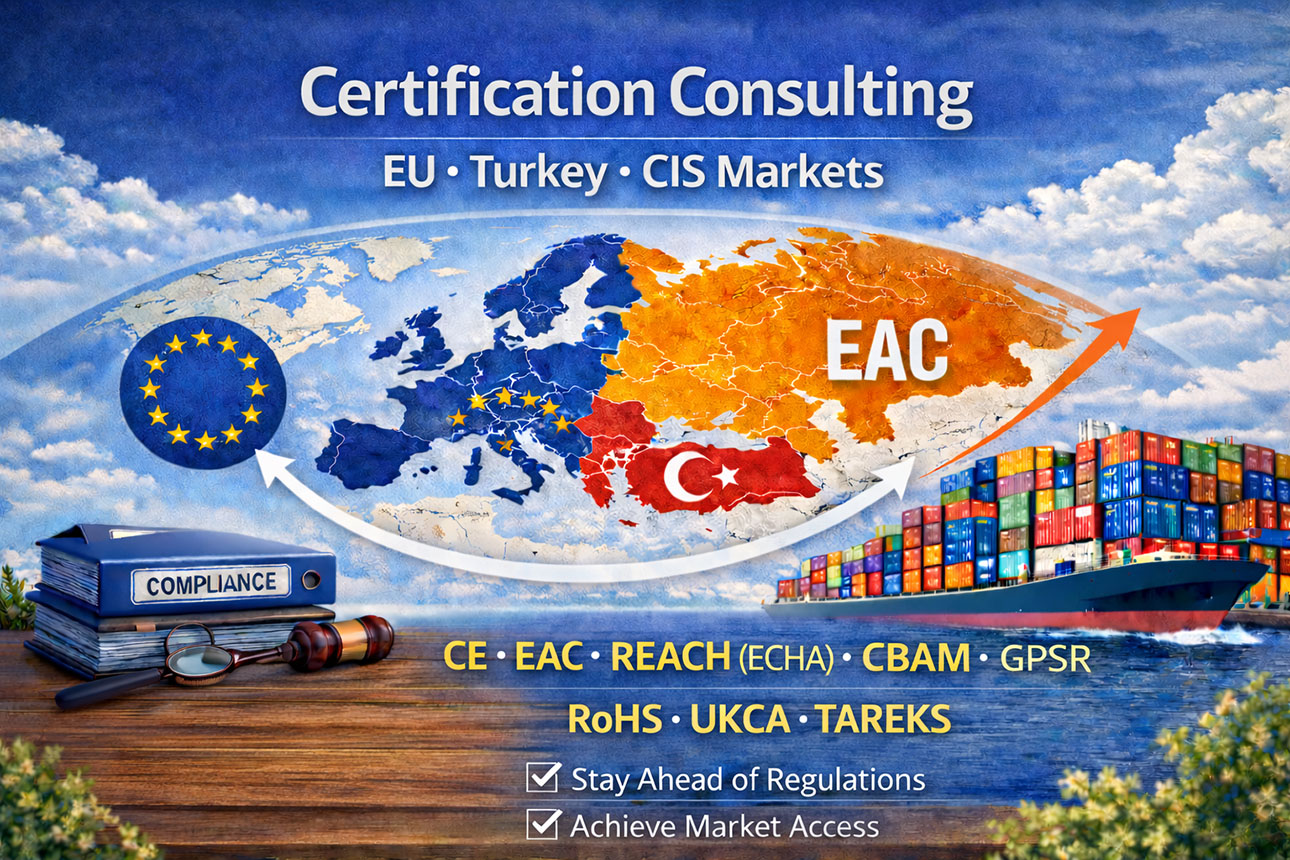
🇹🇷 Certification Consulting EU Turkey: Regulatory Framework and Local Presence
In product certification consulting projects involving Turkey, compliance often depends on the existence of a clearly defined local economic operator.
Turkey remains one of the most underestimated compliance environments for foreign manufacturers.
While CE marking is recognised, the importer of record in Turkey becomes the operational and legal focal point for enforcement. The TAREKS system does not evaluate products in isolation — it evaluates risk based on importer behaviour, historical compliance and administrative profiles.
This means that two identical products can face completely different outcomes depending solely on who imports them.
Companies that treat Turkey as a simplified extension of the EU often discover this only after shipments are blocked, inspections are triggered or testing is repeated locally.
This is why, in Turkey, compliance strategy and partner selection are inseparable.
Institutional reference:
👉 Turkish Standards Institution (TSE)
Related insight:
👉 Business Consulting for Turkey & Balkans
🌐 Product Certification Consulting for CIS and EAEU Markets
CIS and EAEU markets operate under a distinct conformity framework, primarily through EAC certification under TR CU / EAEU regulations.
🌐 The CIS / EAEU Certification Lock-In Risk
The appointment of a Local Applicant for EAC certification is not a formality — it is a transfer of control.
Once certification is issued, the Applicant legally owns the conformity route, which can restrict resale, redistribution or partner changes. This is particularly critical for manufacturers planning multi-country expansion or parallel distribution models.
Choosing the wrong certification scheme does not create inconvenience — it creates dependency.
For regulatory overlap limits, particularly in chemicals:
🧠 What My Certification Consulting Actually Does
I do not intervene at the end of the process.
I intervene before irreversible decisions are made.
My role in product certification consulting is to align product compliance, legal responsibility and market-entry structure into a single, coherent strategy that works under regulatory pressure, not just on paper.
This is what prevents certification rework after shipment, duplicated testing across jurisdictions, delisting from marketplaces and long-term liability exposure for executives and shareholders.
Certification becomes effective only when it reflects how the business truly operates.
🧩 Sector Complexity Acknowledgment
Most of my certification consulting projects involve products with elevated compliance complexity — including machinery, electronics, audio-video equipment and consumer products subject to strict safety and traceability requirements.
These are not generic workflows.
They require precision, sequencing and regulatory foresight.
🤝 From Advisory to Execution
Once the compliance architecture is clearly defined, execution must be consistent.
Testing, technical documentation, authorised representation and operational rollout require local presence and procedural discipline.
For this execution phase, operational implementation must follow a clearly validated strategy.
Testing, technical documentation, authorised representation and procedural rollout require consistency, local coordination and regulatory discipline.
This separation between strategic advisory and execution protects decision-making clarity while ensuring continuity throughout the compliance process.
👉 Explore operational certification services and next steps
🚀 Next Step
International certification is no longer a static requirement.
It is an active enforcement mechanism that affects visibility, logistics and revenue.
Companies that approach it late absorb costs.
Companies that structure it early retain control.
If clarity is established before resources are committed, certification becomes a competitive advantage rather than a recurring obstacle.
👉 Contact me to evaluate your certification strategy before committing resources
Common Questions About Certification Consulting
Is certification required before exporting, or only after entering the market?
Certification should never be approached as a standalone step “before” or “after” exporting.
What matters is how the product will be placed on the market and who will be legally responsible for it.
In some cases, certification is required before the first shipment. In others, certification becomes valid only once a specific legal structure, importer or responsible person is defined. Starting certification without clarifying this sequence often results in documents that are technically correct but legally unusable.
This is why certification must follow market entry logic, not the other way around.
Can CE, EAC or Turkish certifications be reused across different markets?
In most cases, no.
Although technical standards may overlap, EU, Turkish and CIS/EAEU certification systems are based on different legal frameworks and responsibility models. Certificates are generally market-specific and tied to local legal roles, applicants or importers.
Attempting to reuse or “convert” certificates without proper assessment often leads to duplicated costs, rejected documentation or blocked shipments. Any potential reuse of test data must be evaluated case by case, based on product category, regulatory scope and destination market.
Do you provide certification services or issue certificates directly?
No. I do not issue certificates, perform testing or act as a notified body.
My role is certification consulting: helping companies determine what certification is actually required, who should hold it, and when it makes sense to proceed. This advisory phase prevents unnecessary testing, incorrect certification routes and long-term liability exposure.
Once the strategy is clear, operational execution — including certification procedures and documentation management — is handled through Inspira Business and accredited partners.