


European Union, Turkey & CIS Markets
Import export advisory is often described as a logistical activity: goods move from one country to another, documents are prepared, customs clearance is completed.
In reality, import–export is a legal and strategic decision that determines responsibility, regulatory exposure and long-term sustainability.
According to the European Commission, a large share of customs-related delays affecting non-EU companies is not caused by transport issues, but by documentation errors, unclear responsibility or non-aligned compliance frameworks.
In other words, problems arise before the shipment moves — not during transport.
My import export advisory services are designed to help companies structure cross-border operations correctly, ensuring that goods can move predictably, legally and without transferring unmanaged risk to partners.
⚖️ Import Export Advisory Is About Responsibility, Not Transportation
One of the most common misconceptions is treating import–export as a shipping or forwarding issue.
Moving goods is usually the easiest part.
The real complexity lies in defining who is legally responsible for the product once it crosses the border, how compliance obligations are allocated and which risks remain with the exporter or importer.
This becomes particularly critical when operating between the European Union, Turkey and CIS markets, where regulatory systems interact but follow very different enforcement logics.
In recent EU trade assessments linked to CBAM and product safety enforcement, documentation quality and clarity of economic operator roles remain among the primary causes of border holds and post-clearance corrective actions.
👉 EU Customs Controls and Enforcement – European Commission
For an institutional perspective on EU customs responsibility, see:
👉 EU Customs Union – European Commission
🇪🇺 Import Export Advisory for the EU: When It Works — and When It Breaks
Exporting to the EU without establishing a local presence can be a valid strategy, especially when testing demand or working with a strong, experienced importer.
However, EU law places significant responsibility on the economic operator placing the product on the market. Importers are legally accountable for compliance, traceability and post-market obligations. This is why many EU importers refuse to work with suppliers whose documentation, labelling or certification strategy is unclear.
In practice, many export projects fail not because products are non-compliant, but because importers are unwilling to absorb regulatory risk on behalf of foreign manufacturers.
With the enforcement of the General Product Safety Regulation (GPSR – EU 2023/988), this dynamic has become even more rigid.
For a wide range of products, the presence of a clearly identified EU-based Responsible Person is no longer optional.
Without it, customs clearance and marketplace listing can be blocked regardless of technical conformity.
This shifts import–export into a risk management decision rather than a procedural one.
This dynamic is explained in more detail here:
👉 Business Consulting for International Market Expansion
Additional regulatory context for exporters:
👉 CE Certification for Exporters – Practical Guide
Authoritative reference on product responsibility:
👉 Product safety rules in the EU – Your Europe
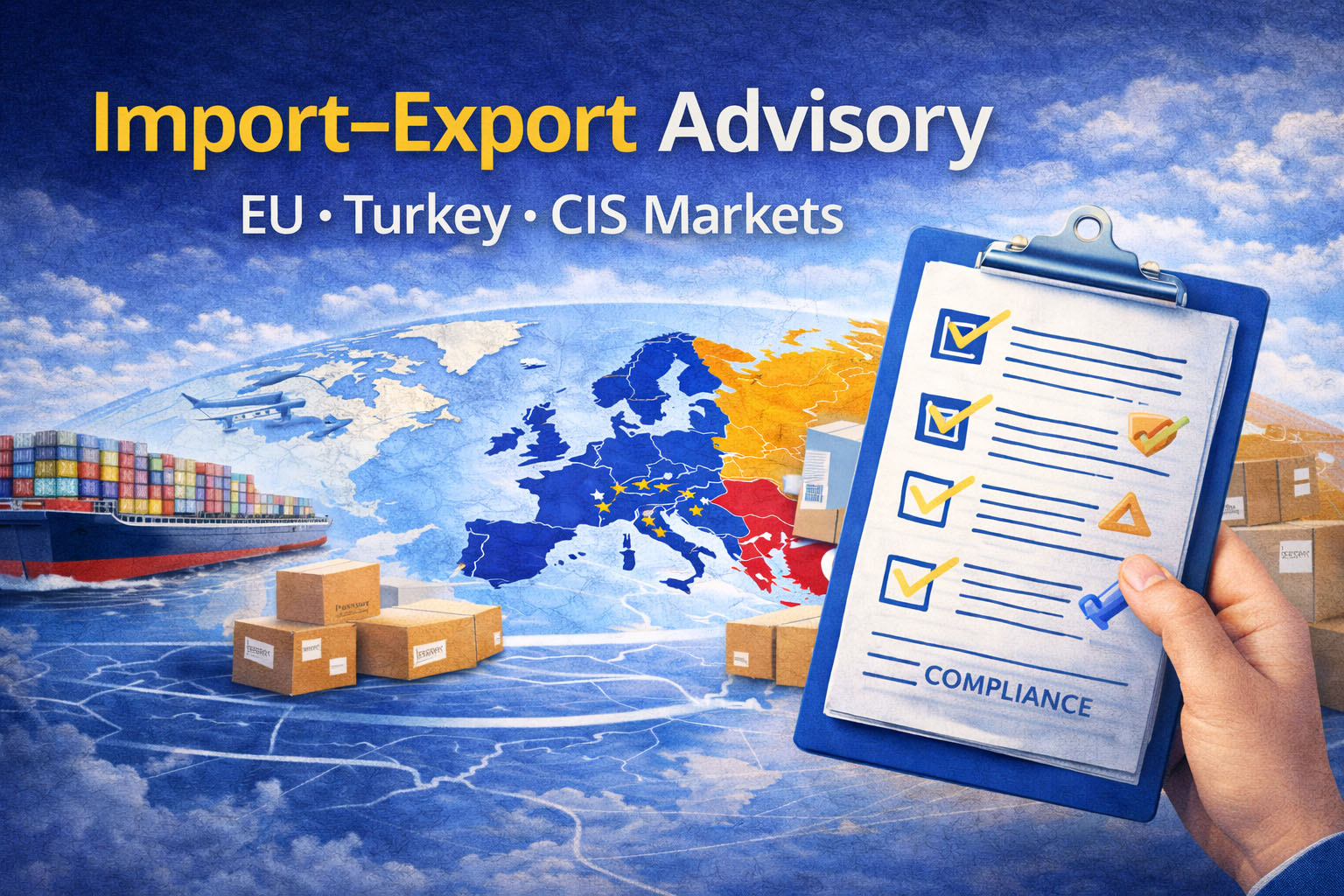
🇹🇷 Import Export Advisory with Turkey: A Different Regulatory Logic
Turkey is often approached as an extension of the EU. From an import–export perspective, this is a frequent and costly assumption.
Although CE marking is recognised, Turkey applies national regulations, strong importer accountability and a higher level of administrative discretion. In many cases, import procedures and compliance requirements depend on having a clearly identified local economic operator.
Turkey operates a risk-based trade control system (TAREKS) that evaluates shipments not only on product type, but also on importer history, HS codes and administrative profiles.
CE marking or A.TR certificates do not bypass these controls.
As a result, shipments that clear EU customs smoothly may still be selected for physical inspection, document verification or local testing upon entry into Turkey.
According to Turkish Ministry of Trade data, inspection frequency for regulated industrial products has increased steadily in recent years, reinforcing the importance of structure and partner selection.
For regulatory context, see:
👉 Turkish Standards Institution (TSE)
Related insight on sequencing and compliance:
👉 Market Entry & Certification Compliance in Turkey
🌐 International Import Export Advisory Between CIS, EU and Turkey
CIS and EAEU markets operate under their own conformity systems, most notably EAC certification under the Technical Regulations of the Customs Union (TR CU / EAEU).
While technical standards may appear similar to EU norms, the legal framework behind them is different.
Under TR CU rules, the certificate applicant must be a legal entity established within the EAEU territory.
Foreign manufacturers cannot hold EAC certificates directly without appointing a local authorised entity.
Companies exporting from CIS markets often assume that certificates or documentation can be reused or adapted with minimal effort. In practice, import–export between CIS, EU and Turkey requires re-alignment of compliance logic, not just translation of documents.
Ignoring this often leads to duplicated costs, re-certification or rejected shipments.
For regional context and market structure:
👉 Doing Business in CIS Countries – 2025 Overview
For chemical and regulatory overlap limits, see:
🧠 How I Work in Import–Export Advisory
This import export advisory approach helps companies avoid regulatory surprises and structure cross-border operations correctly.
I do not act as a freight forwarder, customs broker or logistics provider.
My role is to help companies make the right decisions before goods move, ensuring that import–export operations are legally defensible, commercially sustainable and aligned with long-term international strategy.
This includes clarifying responsibility, assessing regulatory exposure and determining whether import–export is a stable model or simply a transitional phase toward market entry.
🔗 Import Export, Compliance and Market Entry Are One System
Import–export decisions directly affect certification scope, customs responsibility and post-market obligations. Treating these elements separately is one of the most common reasons international operations become fragile over time.
For deeper context, see:
👉 Certification Consulting for EU, Turkey & CIS Markets
👉 Business Consulting for International Market Expansion
🚀 Next Step
Import–export should never be approached as a purely operational task.
When structured correctly, it becomes a controlled and predictable part of international expansion.
When structured incorrectly, it becomes a recurring source of risk.
If you want clarity before committing resources, the first step is a focused assessment.
Common Questions About Personal Branding
What is the difference between import–export advisory and logistics services?
Import–export advisory focuses on decision-making, responsibility and risk allocation, not on transportation or shipment execution.
Logistics providers move goods.
Import–export advisory defines who is legally responsible, how compliance is structured, and whether an export or import model is sustainable in the long term. Many international operations fail not because transport goes wrong, but because responsibility and compliance were never clearly defined before goods moved.
Do I need import–export advisory if I already work with a freight forwarder or customs broker?
Yes, because freight forwarders and customs brokers operate within a structure you provide.
If the structure is unclear — for example, who acts as importer of record, how certification responsibilities are allocated, or which risks remain with the exporter — even the best logistics partner cannot prevent delays, blocked shipments or contractual disputes.
Import–export advisory ensures that operational partners work inside a legally defensible and predictable framework.
Is import–export advisory suitable for companies that only want to export without opening a local company?
Yes, in many cases export without local establishment is possible — but only when responsibilities, documentation and compliance strategy are aligned with the destination market.
In the EU and Turkey, importers carry significant legal responsibility. If this is not clearly structured, importers may refuse cooperation or demand risk transfer back to the exporter. Import–export advisory helps determine whether export-only is viable or whether a different market entry model is required.