


The Reality of Business Consulting in Turkey for Foreign Companies
Business consulting in Turkey requires more than understanding regulations or costs. Turkey is often presented as the perfect bridge between Europe and emerging markets. Industrial capacity is strong, standards look familiar, logistics are efficient, and the market feels accessible. On paper, it all makes sense.
In reality, many international projects in Turkey stall not because the market is difficult, but because the gap between strategy and execution is wider than expected.
My work in business consulting in Turkey starts exactly there: where plans meet local reality, and where decisions taken in the wrong order quietly destroy time, capital, and credibility.
I don’t sell optimism about Turkey. I help companies build the stability required to operate here without constant friction.
For founders and international companies evaluating Turkey as a launchpad, a clear view of institutional support and startup incentives is often a key decision factor.
👉 Turkey startup ecosystem incentives for foreign founders
🧩 What Business Consulting in Turkey Really Requires
Most foreign companies approach Turkey with a European mindset. They assume linear planning: define the strategy, sign contracts, appoint partners, then execute.
Turkey does not work this way.
Here, formal regulations coexist with informal power structures. A signed agreement is often the beginning of a relationship, not the end of a negotiation. Decision-making authority is rarely visible on the org chart. And execution depends less on what is written than on who is truly accountable on the ground.
Effective business consulting in Turkey is not about adding layers of control. It is about removing blind spots early—before they turn into operational dead ends.
This means understanding how market entry, legal structure, partner selection, certification, and daily operations influence each other. When these elements are treated separately, projects slow down. When they are aligned from the start, Turkey becomes predictable.
To gain deeper insight into the tax and operational aspects of doing business in Turkey, I recommend reading my expert interview with Turkish financial and tax consultant Gunes Izbul.
👉 Expert Interview: Business Consulting in Turkey 2026 – Taxes, Labor Costs & Incentives
For macro-economic and institutional context, see:
🔗 World Bank – Turkey Country Overview
🎯Who Benefits Most From This Consulting Approach
I work with foreign entrepreneurs, SMEs, and investment teams who see Turkey as a strategic hub, not a short-term experiment.
Some are entering the market for the first time and need to understand the real implications of setting up a Limited (Ltd) or Joint Stock (AŞ) company. Others are already present but struggling with remote management, partner dependency, or execution fatigue. Many evaluate Turkey alongside Serbia, the Balkans, or CIS markets and want to design a regional structure rather than a country-by-country patchwork.
If you are looking for someone to “fix things quickly”, bypass processes, or rubber-stamp a decision already taken, we are not a fit.
If you want a partner who will challenge assumptions and validate your model against local realities, then business consulting in Turkey becomes a strategic asset rather than a cost.
⚠️ The Operational Mistakes That Quietly Derail Projects
Most stalled projects I see fail for very specific reasons.
One is the remote control illusion: believing Turkey can be managed purely through KPIs, calls, and reporting, without building trust and authority on the ground. Another is partner misalignment: choosing distributors or suppliers based on language skills or price, instead of their real network, influence, and resilience. The third is sequence error: hiring teams, launching sales, or committing capital before regulatory, structural, or operational foundations are actually ready.
These mistakes are rarely dramatic at first. They show up slowly—in delays, excuses, “almost ready” milestones, and growing internal frustration. By the time they are visible on a balance sheet, correction is expensive.
My role in business consulting in Turkey is to force these conversations early, when they are still cheap.
🛠️ The Business Consulting Process in Turkey: From Planning to Execution
I don’t deliver generic reports or recycled frameworks. The process is direct and decision-driven.
We start with a diagnostic discussion that strips away noise. What is your real risk tolerance? How exposed are you to currency volatility? Where does responsibility actually sit? Are your timelines compatible with Turkish administrative and commercial rhythms?
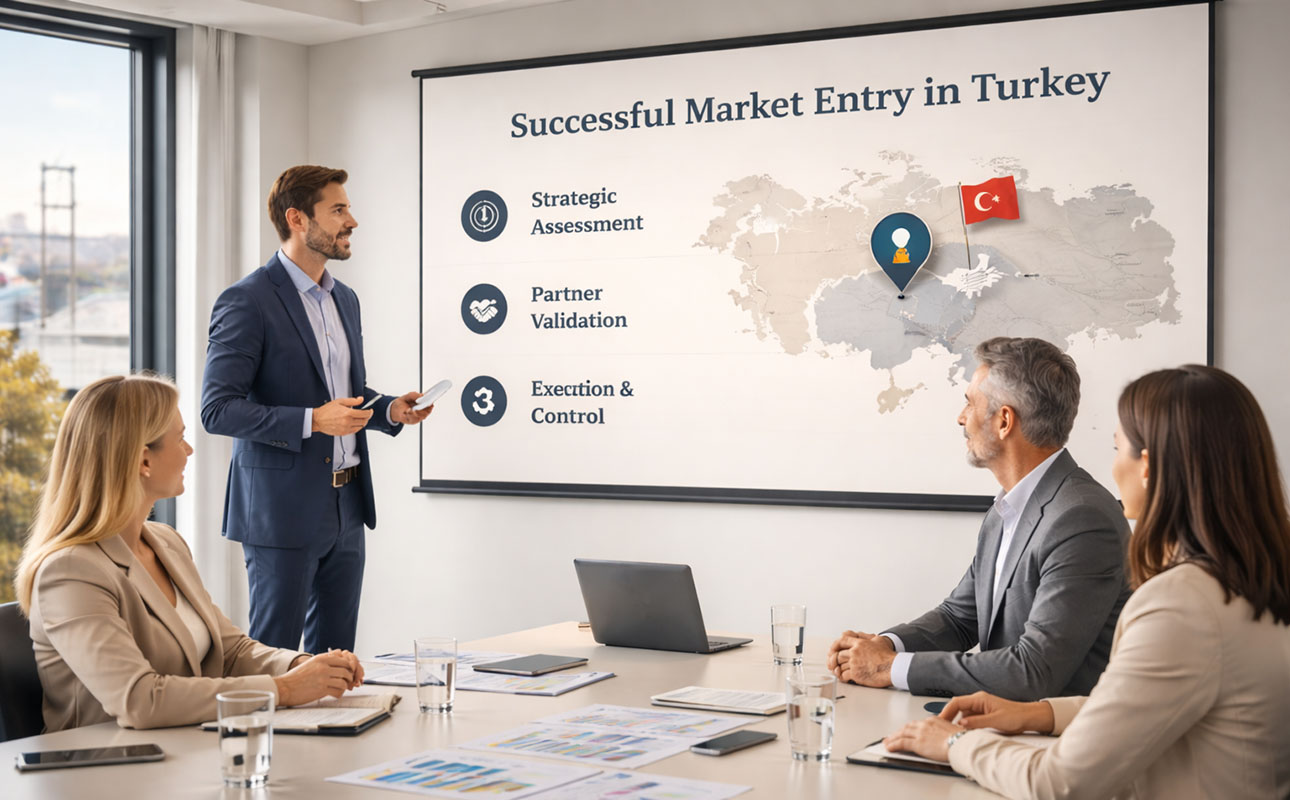
From there, we design the operating architecture: market entry route, legal structure, partner logic, banking and compliance sequencing. Not everything must be done immediately—but everything must be placed in the right order.
When projects move into execution, I stay involved during the critical phase where strategy meets reality: partner negotiations, alignment meetings, early operational steps. This is where most plans either stabilize—or collapse.
Related internal resources:
👉 Market Entry & Certification Compliance in Turkey
👉 How to Do Business in Turkey: Real Costs & Strategy
🌍 Why Turkey Is a Regional Business Hub for International Companies
One of your competitive advantages—and one many consultants miss—is seeing Turkey not as an isolated market, but as part of a wider system.
Turkey connects naturally with the Balkans, the EU, the Middle East, and CIS markets. Companies that structure operations with this in mind gain flexibility in supply chains, manufacturing relocation, and market access. Those who treat Turkey as a standalone project often end up redesigning everything a second time.
This regional perspective is built into my business consulting approach, especially for companies comparing Turkey with Serbia or broader Balkan strategies.
Turkey has become a strategic manufacturing hub for European companies seeking reliable partners, competitive production, and faster access to EU markets.
In this in-depth interview, I explain how to identify trustworthy manufacturers, manage compliance, and build a resilient supply chain in Turkey with the right local strategy.
🔗 Manufacturing in Turkey: How to Find Reliable Partners
For regional economic comparisons, see:
🔗 OECD – Economic Outlook: Turkey
Related internal insight:
👉 Business Consulting for Turkey & the Balkans
🚀 Validate Your Turkey Strategy Before You Commit
Turkey rewards preparation and punishes improvisation.
If you want to understand whether your business model can actually work here—and how to structure it so it doesn’t depend on constant firefighting—the first step is a direct, focused discussion.
👉 Book a Strategic Consulting Session
No sales pitch.
No generic advice.
Just a professional assessment of your project’s viability in the Turkish market, based on experience, not theory.
Frequently Asked Questions on Business Consulting in Turkey
Do foreign companies really need business consulting in Turkey?
In most cases, yes. Turkey combines formal regulations with strong informal business dynamics. Foreign companies often underestimate factors such as decision-making hierarchies, partner accountability, and operational sequencing. Business consulting in Turkey helps reduce uncertainty early, align expectations with local realities, and avoid costly mistakes during market entry or expansion.
What is the difference between market entry consulting and general business consulting in Turkey?
Market entry consulting focuses specifically on how to enter the Turkish market: structure, legal setup, compliance sequencing, and first operational steps. Business consulting in Turkey goes further, supporting ongoing operations, partner alignment, execution issues, and long-term scalability once the company is already active in the market.
Is Turkey suitable only for manufacturing, or also for service and digital businesses?
Turkey is not limited to manufacturing. While industrial production is a major strength, the country also offers strong opportunities for service-based, digital, and hybrid business models. The key challenge for foreign companies is not the sector itself, but structuring operations correctly to match local business practices, regulatory expectations, and execution speed.