


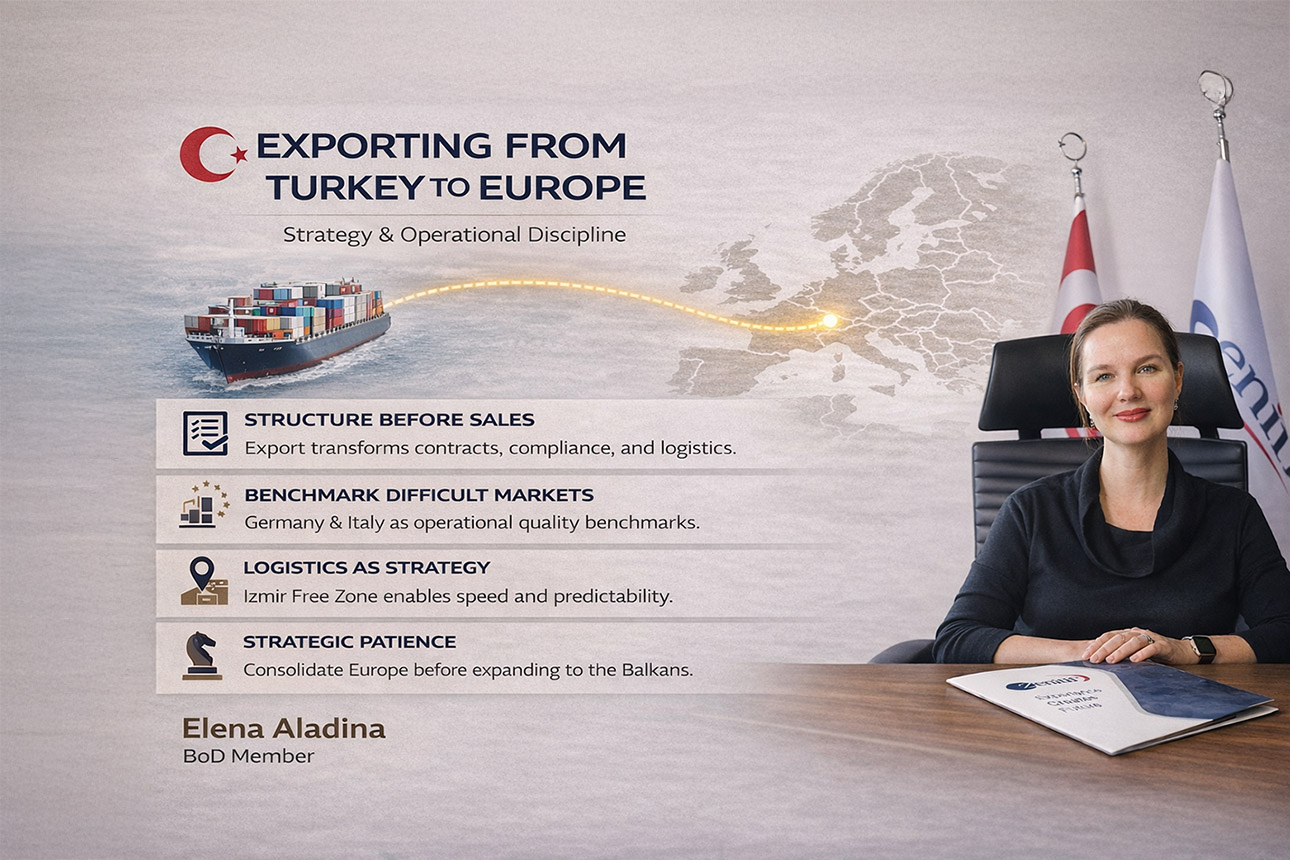
Exporting from Turkey to Europe: Strategy and Lessons from Zenith Izmir
Exporting from Turkey to Europe is no longer simply a commercial objective. It has become a test of organizational maturity.
As European supply chains shorten and nearshoring gains momentum, Turkish manufacturers are in a strong position.
The EU remains Turkey’s largest trading partner, accounting for roughly 40% of total exports, according to official data from the European Commission.
👉 European Commission – EU Trade Relations with Turkey
In this environment, competitiveness is no longer defined by price alone, but by structure, compliance, and execution.
In my work focused on execution-driven market entry & strategic business consulting for foreign companies in Turkey, I regularly meet manufacturers with impressive production capabilities, yet insufficient internal preparation for the operational realities of mature EU markets.
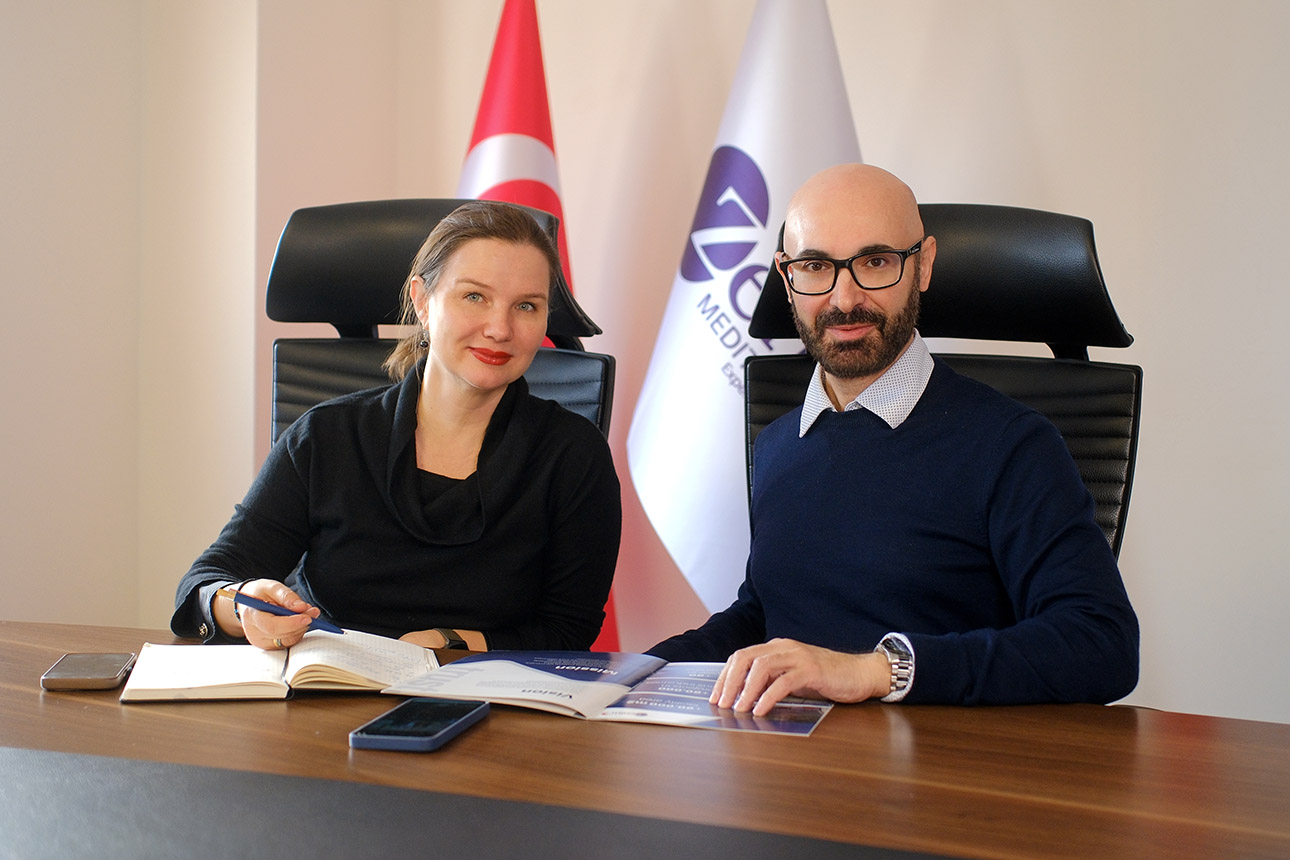
To understand what real export readiness looks like in practice, I met with Elena Aladina, BoD Member of Zenith Izmir, at their headquarters in Izmir.
Exporting from Turkey to Europe in Practice: The Zenith Izmir Case
Zenith operates in the field of shelving systems and intralogistics storage solutions, primarily serving retail and commercial environments. The company does not focus on standardized mass production. Instead, each project is engineered around the operational needs of the client.
This distinction matters in Europe. Storage is no longer just about metal racks; it is about optimizing expensive retail space and ensuring long-term reliability. Zenith’s sixty years of experience have shaped a production model that integrates engineering standards, documentation discipline, and consistent delivery performance.
Today, Zenith exports to Germany, Italy, and Spain—markets known for strict expectations and low tolerance for operational inconsistency.
Building a Mindset for EU Market Entry
Defining the Value Proposition
Mauro Benigno:
Elena, to set the stage: how do you define Zenith’s identity to a European client encountering you for the first time?
Elena Aladina:
We design and manufacture shelving systems and storage solutions mainly for retail and commercial use. But what defines us is not just the product—it’s the process. We don’t sell standard components. We study how the client’s space functions and build around that reality. In Europe, durability and space optimization are economic factors, not aesthetic preferences.
EU Compliance in Turkey to Europe Export
Mauro Benigno:
Zenith has decades of experience. How has that shaped your approach to European compliance standards?
Elena Aladina:
Experience teaches realism. Years ago, many Turkish companies believed that a good product was enough. Today we know that international growth only works when the internal structure is solid. Documentation, traceability, certification—these are not secondary elements. They are fundamental. A client in Germany wants to understand specifications, safety standards, and delivery reliability. That shift—from pure manufacturing to structured engineering compliance—has been essential.
Entering Demanding EU Markets from Turkey
Mauro Benigno:
You are active in Germany, Italy, Spain, Saudi Arabia, and South Africa. These are demanding and diverse markets. Why did you decide to start there?
Elena Aladina:
Precisely because they are demanding. If you meet the expectations of a client in Germany or Northern Italy, you are forced to raise your internal standards. That discipline improves the company as a whole. It was not a marketing decision—it was a structural one.
Frequently Asked Questions onTurkey Startup Incentives
The Role of the Izmir Free Zone in EU Export Operations
Mauro Benigno:
Izmir is increasingly seen as an export hub. Why did Zenith choose to operate from the Izmir Free Zone?
Elena Aladina:
For an export-oriented company, location is a logistics asset. Izmir offers a strong industrial ecosystem and access to European routes. The Free Zone simplifies customs procedures and creates an environment tailored to international trade. It reduces friction. When you compete in Europe, speed and predictability are as important as price.
Common Pitfalls for Turkish Manufacturers Entering the EU
Mauro Benigno:
Where do other manufacturers typically go wrong when entering the European market?
Elena Aladina:
They underestimate the invisible work. Export is not simply sales with international shipping. It affects contracts, liability, packaging standards, after-sales structure, and internal coordination. If export compliance is not organized before the first contract is signed, delays and unexpected costs follow. Export requires structure, not improvisation.
Strategic Patience: Europe First, Then the Balkans
Mauro Benigno:
There is frequent discussion about expansion into the Balkans. Is that on Zenith’s agenda?
Elena Aladina:
Not yet. And that is deliberate. We prefer to consolidate our position in our current markets before expanding further. Entering new regions without the ability to maintain the same service quality can dilute reputation. When we move into new markets, we want to guarantee the same level of operational control.
Final Advice
Mauro Benigno:
What would you say to a Turkish manufacturer at the beginning of its export journey?
Elena Aladina:
Treat export as an investment in structure. Align your processes with EU standards before you are forced to. Build internal discipline first. Turkey has strong production capacity, but sustainable international growth requires patience and preparation.
Why Structured Turkey to Europe Export Works
Zenith’s trajectory illustrates a recurring pattern I observe in successful international expansion.
Rather than chasing easy markets, they benchmarked themselves against demanding EU economies. That decision forced internal alignment—technical documentation, engineering compliance, logistics precision. This is where many export initiatives fail: ambition moves faster than structure.
Second, logistics is treated as strategy. Operating from Izmir and the Free Zone is not only about tax efficiency; it is about predictable execution. In Europe, predictability builds trust.
Third, expansion is approached cautiously. Over-expansion without supply chain bandwidth is a common failure pattern. Strategic patience protects brand credibility.
This is exactly where execution-driven market entry & strategic business consulting for foreign companies in Turkey becomes relevant: translating export ambition into operational architecture.
The European market does not reward enthusiasm. It rewards consistency.
Is Your Company Ready for Turkey to Europe Export?
Exporting to Europe is an organizational transformation. Compliance (CE marking, ISO standards), logistics (Incoterms, warehousing), documentation, and partner strategy must be aligned before the first shipment leaves the factory.
If your company is evaluating expansion into Europe, a structured framework grounded in execution-driven market entry & strategic business consulting for foreign companies in Turkey can significantly reduce risk and improve time-to-market.
Mauro Benigno
International Business Consultant
execution-driven market entry & strategic business consulting for foreign companies in Turkey
👉Export Readiness Assessment for EU Market Entry
🔗 Related insights:
Frequently Asked Questions on Exporting from Turkey to Europe
What does exporting from Turkey to Europe require beyond production quality?
Exporting from Turkey to Europe requires more than competitive pricing or strong manufacturing capabilities. Companies must align with EU compliance standards, prepare technical documentation, understand CE marking requirements, structure logistics correctly, and define clear contractual responsibilities. Successful exporters treat market entry as an operational transformation, not simply an extension of domestic sales.
Why is the Izmir Free Zone advantageous for Turkish exporters?
The Izmir Free Zone (ESBAŞ) offers a structured ecosystem designed for export-oriented manufacturing. It simplifies customs procedures, reduces administrative friction, and improves logistics efficiency through proximity to European transport routes. For companies targeting EU markets, speed, predictability, and compliance management often become competitive advantages.
How can Turkish manufacturers assess their readiness for the European market?
Export readiness involves evaluating internal processes before entering EU markets. This includes checking compliance with European standards, reviewing documentation and certification procedures, assessing logistics capabilities, and ensuring the company can provide consistent after-sales support. A structured export readiness assessment helps identify operational gaps and reduce risk before international expansion.