


By Mauro Benigno | Interview with Murat Özgürtaş on ESBAŞ Free Zone İzmir and Business Expansion in Turkey
For companies planning business expansion in Turkey, the choice of location is not a logistical detail. It is a financial and strategic decision that shapes the entire operating model.
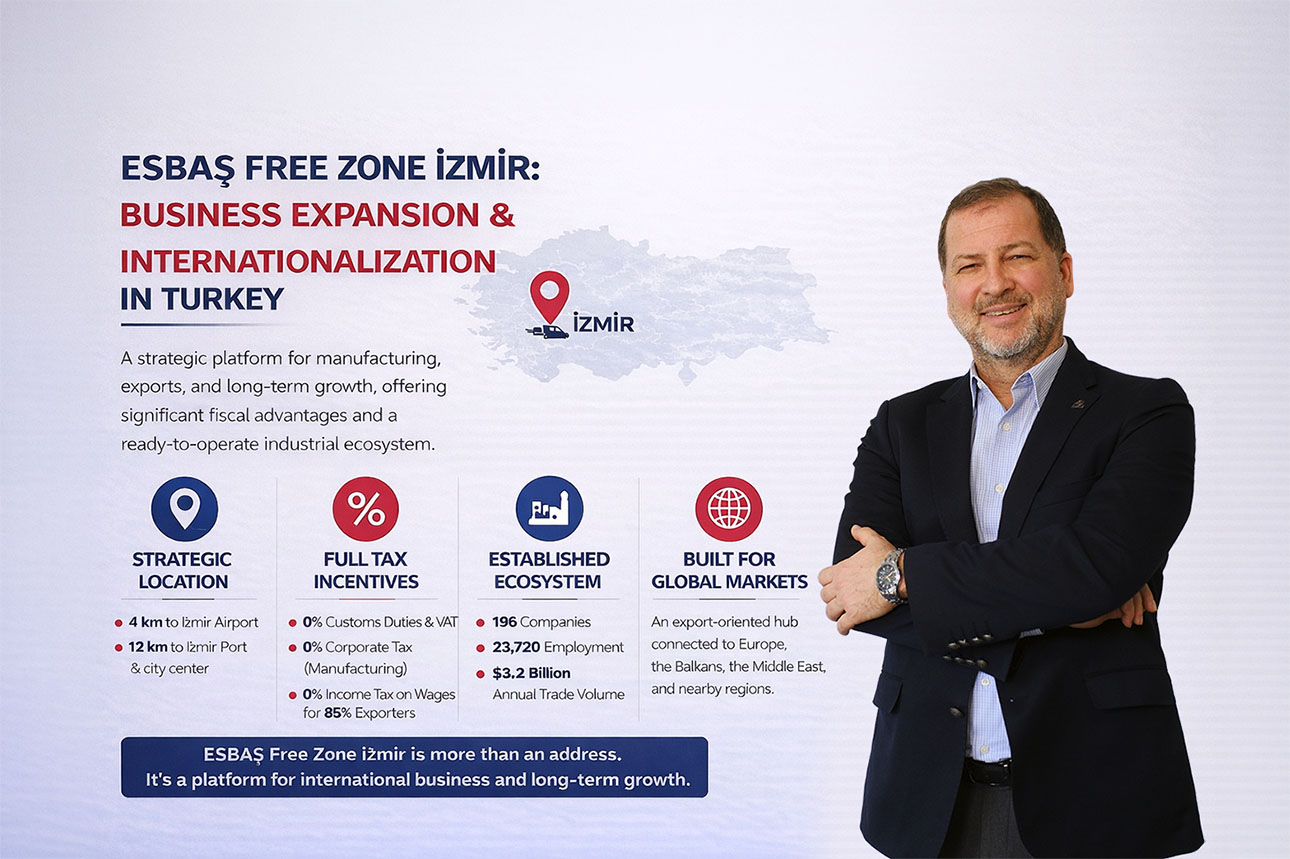
İzmir and more specifically the ESBAŞ Aegean Free Zone — has become one of the most compelling options for foreign investors looking to build a production base, export platform, or regional hub in Türkiye. What makes it relevant is not only geography, but the combination of industrial infrastructure, export orientation, free zone incentives, and a business environment designed for international operations. ESBAŞ and institutional investment sources describe the Aegean Free Zone as a manufacturing-focused ecosystem in Gaziemir, built on 620 acres, located around 4 km from İzmir Adnan Menderes Airport and roughly 12 km from the port/city center, with established infrastructure for investors.
I discussed these dynamics with Murat Özgürtaş, Investment Coordination Director at ESBAŞ, to better understand why this free zone continues to attract export-oriented manufacturers and international investors and why more companies are adding İzmir to their market entry strategy for Turkey.
For many companies, business expansion in Turkey depends on choosing the right industrial platform from the very beginning.
Why ESBAŞ Matters for Foreign Companies Entering Turkey
Mauro Benigno: Murat, when foreign companies evaluate Turkey, they almost always begin with Istanbul. Why should İzmir — and ESBAŞ in particular be part of that conversation?
Murat Özgürtaş:
Istanbul is naturally the financial and commercial reference point. But for companies that want to manufacture, assemble, export, and scale, the logic can be different. İzmir offers a strong industrial culture, easier operating conditions, and a location that is highly practical for export-oriented activity. ESBAŞ is not simply a registered zone on paper. It is an ecosystem built around production and international trade.
Mauro Benigno: So the real issue is not only “where to be in Turkey,” but “how to build the right structure.”
Murat Özgürtaş:
Exactly. For many foreign investors, the better question is not just where to open an office, but where to create a platform that supports growth, exports, and long-term operational efficiency.
ESBAŞ Free Zone İzmir and Business Localization in Turkey
For companies evaluating business localization in Turkey, ESBAŞ is relevant because it supports more than a simple presence. It is particularly well suited to companies that want to combine production, assembly, storage, supply-chain coordination, and export operations in one location.
Turkey’s official investment framework highlights the main advantages of operating in free zones: 100% exemption from customs duties, 100% VAT exemption, 100% corporate income tax exemption for manufacturing companies, and 100% exemption from income tax on employees’ wages for companies that export at least 85% of the FOB value of the goods they produce in free zones. Official guidance also states that goods may remain in free zones for an unlimited period and that profits can be transferred abroad without restriction.
That means the value of a zone like ESBAŞ is not only fiscal. It is also operational. For the right company, it can improve cash flow, customs handling, import-export planning, and the overall speed of execution.
Companies exploring international business consulting in Turkey should look at free zones not only as incentive structures, but as tools for building a stronger operating model.
What Kind of Companies Should Consider ESBAŞ?
Mauro Benigno: What type of companies usually find ESBAŞ most relevant?
Murat Özgürtaş:
Typically, companies that are genuinely export-oriented. That includes manufacturers, industrial suppliers, technical producers, and businesses that want to use Turkey not only as a domestic market, but as a base for surrounding regions.
From a strategic perspective, ESBAŞ is especially relevant for:
European manufacturers pursuing nearshoring and shorter supply chains
Russian and CIS companies looking for a structured base for production, storage, export coordination, or regional business development
Industrial businesses importing machinery, components, or intermediate goods and looking for a more efficient customs and tax environment
Foreign investors building a long-term Turkey hub rather than a minimal commercial presence
Export-oriented companies targeting Europe, the Balkans, the Middle East, and nearby markets
Institutional İzmir investment sources describe the Aegean Free Zone as one of the city’s most established free zone platforms, and ESBAŞ today represents a significant industrial ecosystem with 196 companies and approximately 23,720 total employment.
ESBAŞ can be one component of a broader entry plan. For the commercial and operational framework, see Business Consulting in Turkey.
The Strategic Value: More Than Tax Incentives
Mauro Benigno: Many investors still think of a free zone mainly as a tax tool. What is the real operational value of ESBAŞ?
Murat Özgürtaş:
The tax side is important, of course. But the real advantage is that the free zone structure reduces friction across the whole operating model. Importing production inputs, managing customs processes, organizing export flows, and scaling manufacturing activity can all be more efficient in the right free zone setup than in a standard structure.
For export-oriented companies, that changes the economics of the business. It is not just about paying less. It is about operating better.
This is exactly why companies looking for business consulting in İzmir should evaluate ESBAŞ not as a simple address, but as a strategic platform.
Trade Volume, Infrastructure, and Ecosystem Density
The Aegean Free Zone is not a theoretical investment concept. It is a long-established industrial platform. ESBAŞ describes it as a free zone with a strong manufacturing focus, while recent reporting on Turkey’s free zones indicates that the Aegean Free Zone accounted for about $3.2 billion in total trade volume, making it one of the country’s most significant free-zone ecosystems.
That matters because companies entering such an environment do not start from zero. They enter a zone where infrastructure, customs logic, industrial services, and supplier networks are already part of the operating landscape.
Mauro Benigno: So one of the advantages is not only legal structure, but ecosystem density.
Murat Özgürtaş:
Exactly. Companies benefit from being in a place where international business is already part of daily operations.
The ROI Logic: How ESBAŞ Can Affect Financial Performance
Mauro Benigno: Let’s talk in practical terms. How should a foreign investor think about the financial impact of ESBAŞ?
Murat Özgürtaş:
The right way to think about it is through return on structure, not just cost. For the right business model, the free zone framework can materially improve financial performance in three main ways.
First, corporate tax efficiency for manufacturing companies.
Second, payroll tax efficiency for manufacturers that meet the export threshold.
Third, VAT and customs efficiency, which directly affects working capital and the speed of capital rotation.
When combined with a production-oriented environment and established infrastructure, those advantages can make a meaningful difference to a company’s break-even path and operating resilience.
This is especially important for companies entering Turkey in sectors where margins, lead times, and working capital discipline matter.
Businesses planning export consulting for Turkey or a broader manufacturing setup should assess ESBAŞ through this ROI lens, not only through headline tax incentives.
Setup Speed and Business Execution
Another reason ESBAŞ deserves attention is execution speed. ESBAŞ highlights its support infrastructure for investors, and the zone’s positioning is clearly built around operational readiness. While setup times vary depending on the project and structure, the practical value for investors is the same: a free-zone environment designed for international companies tends to reduce administrative friction compared with a less structured market entry route. ESBAŞ also emphasizes that the zone is fully infrastructure-ready and manufacturing-focused.
For companies making board-level decisions about Turkey, speed matters. Reducing uncertainty at the setup stage is often as important as reducing cost.
Why İzmir Matters for International Business Expansion
Mauro Benigno: Beyond ESBAŞ itself, what makes İzmir strategically attractive for international expansion?
Murat Özgürtaş:
İzmir is often underestimated by foreign investors who approach Turkey only through Istanbul. But for manufacturing, exports, and international operations, İzmir offers a very strong value proposition. It has industrial depth, logistics relevance, a mature business culture, and access to technical talent.
Institutional business sources describe İzmir as Turkey’s second largest industrial city after İstanbul, with companies active in dozens of sectors and exports reaching more than 200 countries.
That positioning gives İzmir real strategic value for companies that want to connect Turkey, Europe, the Balkans, and nearby growth markets through one operating base.
Companies looking at international expansion services often underestimate how much the right Turkish location can influence scalability, supply-chain resilience, and execution quality.
ESBAŞ as Part of a Turkey Market Entry Strategy
A serious market entry strategy for Turkey should not begin with paperwork. It should begin with structure.
That means asking the right questions:
Is the goal domestic sales, export production, or both?
Does the company need a standard Turkish entity or an export-oriented free zone structure?
Is the project based on manufacturing, sourcing, storage, assembly, or partner development?
Which location best supports the intended operating model?
How will customs, working capital, and regional market access be managed?
This is where ESBAŞ becomes especially relevant. For the right business profile, it is not simply a location. It is a platform.
Companies that need local partner search in Turkey or a full operating structure in Türkiye should evaluate ESBAŞ as part of a broader long-term business architecture.
Final Thoughts: ESBAŞ, İzmir and Internationalization in Turkey
For foreign companies planning business expansion in Turkey, ESBAŞ should be evaluated not simply as a tax-advantaged zone, but as a complete operating environment for manufacturing, localization, export coordination, and long-term regional growth.
For European companies, that can mean a stronger nearshoring model with access to Turkey’s industrial base and export infrastructure. For Russian and CIS companies, it can mean a more structured gateway for international operations, regional trade planning, and business relocation logic within a stable industrial framework.
The broader point is simple: business expansion in Turkey is not only about opening a company. It is about choosing the right architecture for growth.
And for many export-oriented businesses, ESBAŞ Free Zone İzmir deserves to be part of that decision.
Looking at Business Expansion in Turkey or İzmir?
I support foreign companies with international business consulting in Turkey, including:
business localization planning
partner search and local partner search in Turkey
legal and operational structuring support for Turkey market entry
If your company is evaluating a presence in Turkey — whether through a free zone structure, a local company setup, or a broader regional model — feel free to contact me for a direct exploratory conversation.
External resources
Frequently Asked Questions on Business Expansion and Internationalization in Turkey
Why should foreign companies consider ESBAŞ Free Zone İzmir for business expansion in Turkey?
ESBAŞ Free Zone İzmir is an attractive option for foreign companies because it combines strategic location, industrial infrastructure, export orientation, and free zone incentives in one operating environment. For companies planning manufacturing, assembly, storage, or export operations, it can offer a more efficient structure than a standard setup in Turkey.
What are the main advantages of operating in a Turkish free zone like ESBAŞ?
The main advantages include exemption from customs duties, VAT exemption, corporate income tax exemption for manufacturing companies, and wage tax exemptions for eligible export-oriented manufacturers. Beyond tax benefits, companies also value the operational advantages of a more structured environment for customs, logistics, and international trade.
What type of companies is ESBAŞ most suitable for?
ESBAŞ is particularly suitable for export-oriented manufacturers, industrial suppliers, European companies pursuing nearshoring, and Russian or CIS businesses looking for a structured base in Turkey. It is especially relevant for companies that want to use Turkey not only as a domestic market, but as a platform for regional growth and international operations.