


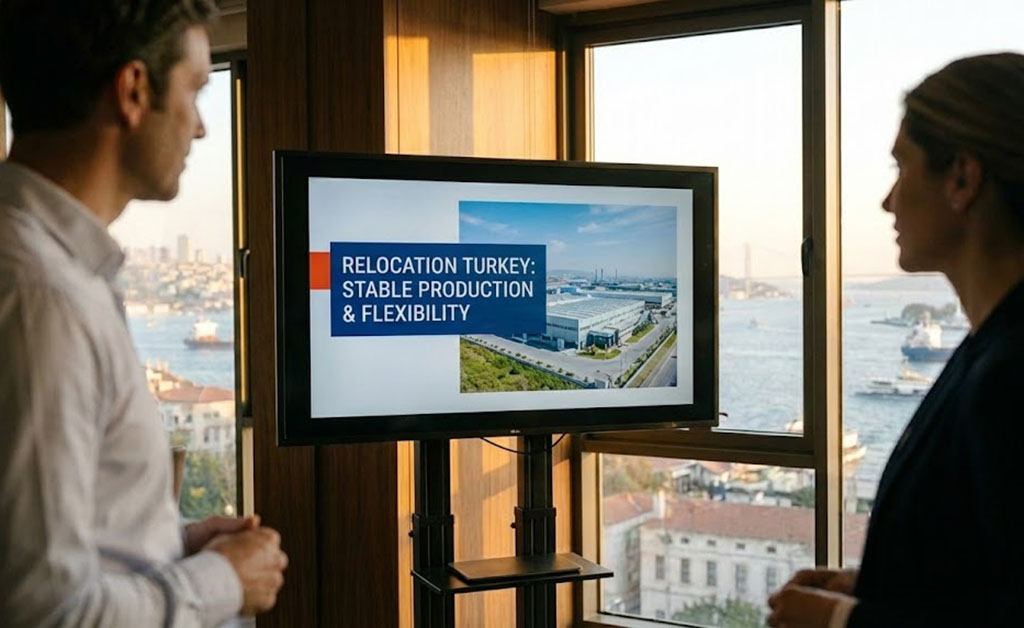
Manufacturing Relocation to Turkey in 2026: Factory, Supplier & Incentive Strategy
Manufacturing relocation to Turkey can mean very different things: outsourcing a component to a Turkish supplier, moving selected production steps, establishing a local company, operating from an organized industrial zone, or making a larger greenfield or brownfield investment. The right structure depends on how much capital, control and local presence the project actually needs.
Türkiye is attractive because it combines a broad supplier base with industrial infrastructure and access to European, Middle Eastern and regional markets. The decision should still be made product by product: tooling, quality standards, energy needs, labour profile, logistics, certifications and customs treatment can outweigh headline wage or tax comparisons.
Türkiye’s industrial platform in 2026
The Republic of Türkiye Investment Office reports 392 organized industrial zones across the country in 2026, with 274 operational, as well as 19 free zones. OIZs provide industrial infrastructure and can offer location-specific advantages. Free zones are separate regimes designed around export-oriented activity and can provide significant tax and customs benefits for qualifying operations.
For labour-cost modelling, the same official source lists the 2026 gross minimum monthly wage at TRY 33,030 and a total employer cost for the manufacturing sector of TRY 39,223.13 under the stated social-security premium conditions. This is a statutory reference point, not a realistic salary assumption for every technician, engineer or skilled operator; actual payroll must be built role by role.
Official references: Investment Zones and Cost of Doing Business.
Start with the operating model
Many companies do not need to establish a Turkish entity on day one. Contract manufacturing or direct supplier relationships can be used to validate a production route before committing to fixed assets. A local company becomes more relevant when the project requires local employees, inventory, investment incentives, direct control of a facility, local invoicing or a long-term operating base.
For the wider decision framework, see Manufacturing Relocation Consulting for Turkey & the Balkans.
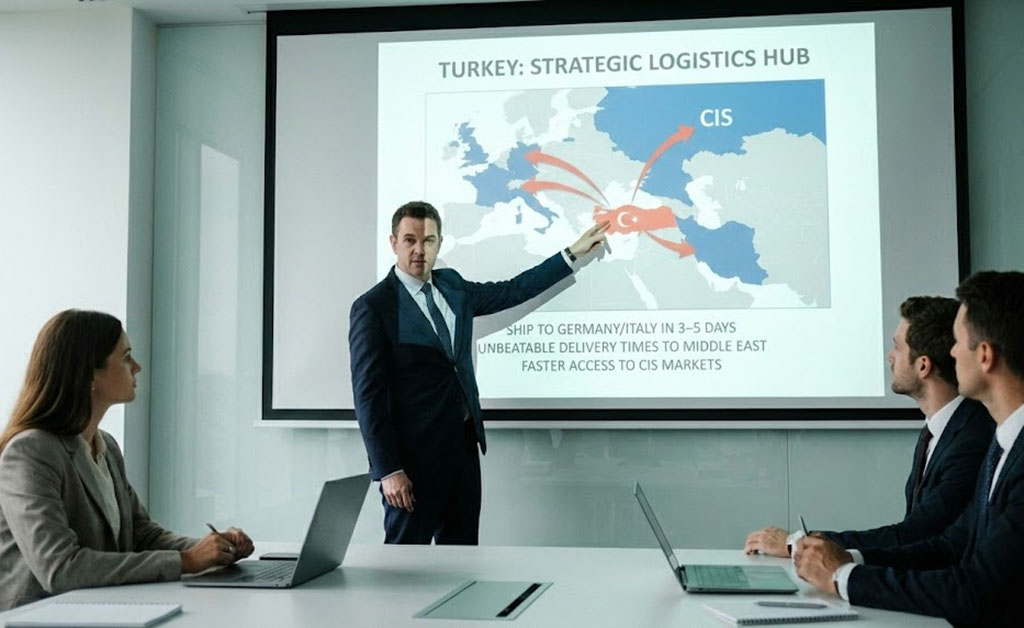
OIZ, free zone or ordinary industrial location?
An organized industrial zone can be attractive when ready industrial infrastructure, utility access and a manufacturing ecosystem matter. A free zone may be relevant for export-oriented manufacturing, but the tax treatment should be checked against the exact activity and export profile. For example, the official free-zone guidance links the employee wage income-tax exemption to manufacturers exporting at least 85% of the FOB value of the goods they produce in the zone.
That is why I do not model a free zone as a generic “zero-tax” solution. The correct comparison includes the activity licence, location, customs flow, VAT treatment, employee profile, export share, property or lease costs, logistics and the ability to use the incentive over the planned investment horizon.
Supplier and factory due diligence
Turkey has supplier depth, but a large supplier pool also means quality varies. A shortlist should be verified against the actual technical requirement: machine list and usable capacity, quality systems, certifications, inspection equipment, subcontracting, tooling ownership, traceability, export experience, engineering response, financial stability and management communication.
I normally prefer a staged validation: document review, technical discussion, factory visit, sample or pilot batch, agreed acceptance criteria and then ramp-up. For companies sourcing rather than relocating a facility, Manufacturing in Turkey: How to Find Reliable Partners goes deeper into supplier selection.
Incentives should be the second calculation, not the first
Türkiye has general, regional, strategic, employment, R&D and location-based incentive mechanisms. They can materially change project economics, but eligibility must be confirmed for the exact project. I therefore build the base case without incentives and then add only benefits that can be documented and realistically obtained.
Customs, origin and product compliance
Türkiye’s customs union with the EU is important for industrial trade, but it does not remove every customs or regulatory question. Product compliance, importer responsibilities, conformity assessment, labelling and sector rules still have to be mapped. An A.TR document concerns free circulation in the EU–Türkiye customs union; it is not proof of preferential origin.
Where preferential origin matters, the applicable rule should be checked at HS-code and agreement level. Under the revised Pan-Euro-Mediterranean framework, origin requirements are product-specific and may involve cumulation. Do not design a relocation model around a generic local-content percentage.
For this part of the project, see Turkey Market Entry Compliance & Certification.
A practical implementation sequence
A typical project can be divided into six gates: feasibility; location and supplier screening; technical/commercial due diligence; pilot production; legal, quality and compliance alignment; and controlled ramp-up. The time required depends on product complexity, tooling, permits, machinery, certification and whether the project is supplier-based or asset-heavy. A 90–180 day pilot planning horizon can be useful for a focused validation, but it is not a promise that every relocation can reach full production within that period.
When Turkey is the stronger option
Turkey is particularly worth testing when the project benefits from a deep supplier ecosystem, multiple alternative vendors, engineering capability, established industrial zones, export infrastructure or the possibility of scaling beyond a single supplier. The Western Balkans may be stronger when proximity to Central Europe, a smaller operational footprint or a specific local specialization dominates the decision.
For the alternative regional route, compare Manufacturing Relocation to the Western Balkans. For company and commercial setup, see Business Consulting in Turkey.
If you are evaluating a Turkish factory, supplier or industrial-zone project, I can help structure the feasibility model, shortlist and due diligence before you commit capital or production volume.
Frequently Asked Questions About Manufacturing Relocation to Turkey
Is manufacturing relocation to Turkey only about reducing production costs?
No. The stronger cases usually combine supplier depth, production capability, logistics, resilience and market access. Lower cost can support the business case, but quality, capacity, engineering response and total landed cost are more important than a headline wage comparison.
How long does it take to validate production in Turkey?
A focused supplier or pilot-production validation can often be structured over a 90–180 day planning horizon, but the actual schedule depends on tooling, product qualification, machinery, certification, permits and the chosen operating model. Full relocation can take substantially longer.
Do companies need a Turkish legal entity to start?
Not always. Contract manufacturing or direct supplier relationships can be used before incorporation. A Turkish entity becomes more relevant when local employment, inventory, direct investment, incentives, facility control or long-term local operations are required.