


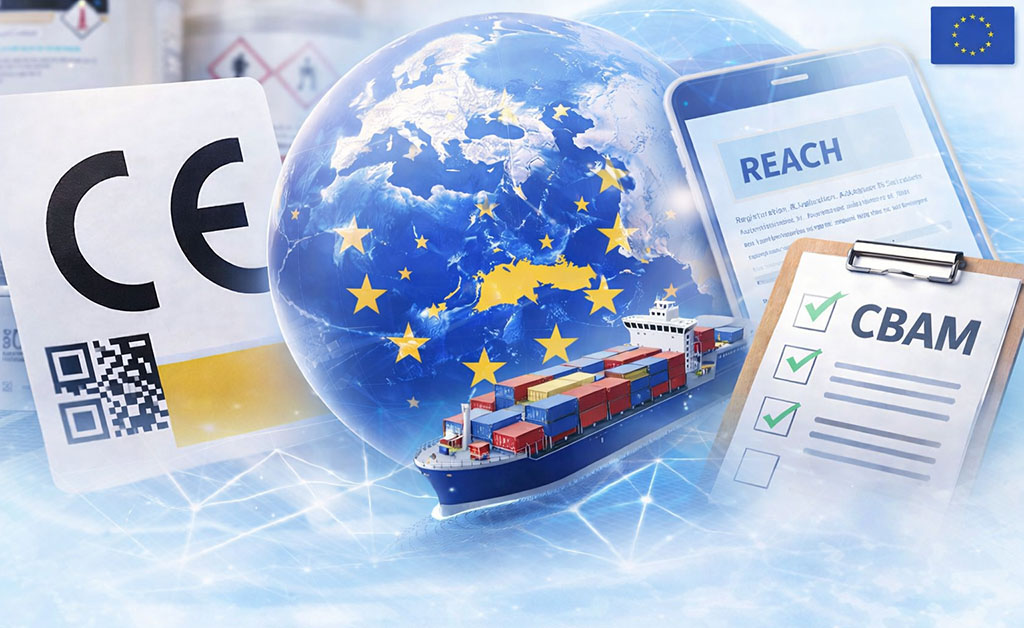
CE Certification, Labelling, REACH and CBAM Requirements for Non-EU Exporters
Navigating CE certification for non-EU exporters requires understanding more than just technical standards; it demands a strategic approach to EU market access.
CE certification for non-EU exporters, along with REACH and CBAM compliance, represents the main regulatory barrier facing manufacturers entering the European market. In reality, the real barrier to entry is regulatory compliance strategy.
CE certification, product labelling, REACH obligations, technical documentation and CBAM requirements are not optional steps or bureaucratic formalities. They are legal conditions for market access. Yet many companies approach them too late, or with unrealistic expectations, turning compliance into an expensive and frustrating obstacle rather than a structured process.
After working with manufacturers from Turkey, CIS countries and other non-EU markets, I have seen the same mistakes repeated time and again. This article explains what really matters before exporting products to the EU, and how to avoid errors that often emerge only when products are already at the border.
📄 Understanding CE Certification for Non-EU Exporters
One of the most persistent misconceptions is the idea that CE certification is a document that can simply be “obtained”.
For international companies, CE certification for non-EU exporters is not a single certificate issued by an authority. It is the outcome of a structured conformity process defined by EU law. This process starts with identifying the applicable EU directives and regulations, continues with the correct conformity assessment route, and ends with the preparation of technical documentation and the Declaration of Conformity.
What many companies underestimate is that legal responsibility matters as much as technical compliance. The roles of manufacturer, importer and authorised representative are clearly defined under EU law, and mistakes in assigning these roles often become visible only during inspections or customs checks.
Official EU guidance:
🔗 CE marking guidance by the European Commission
For a structured advisory view that connects CE certification with market-entry strategy, see:
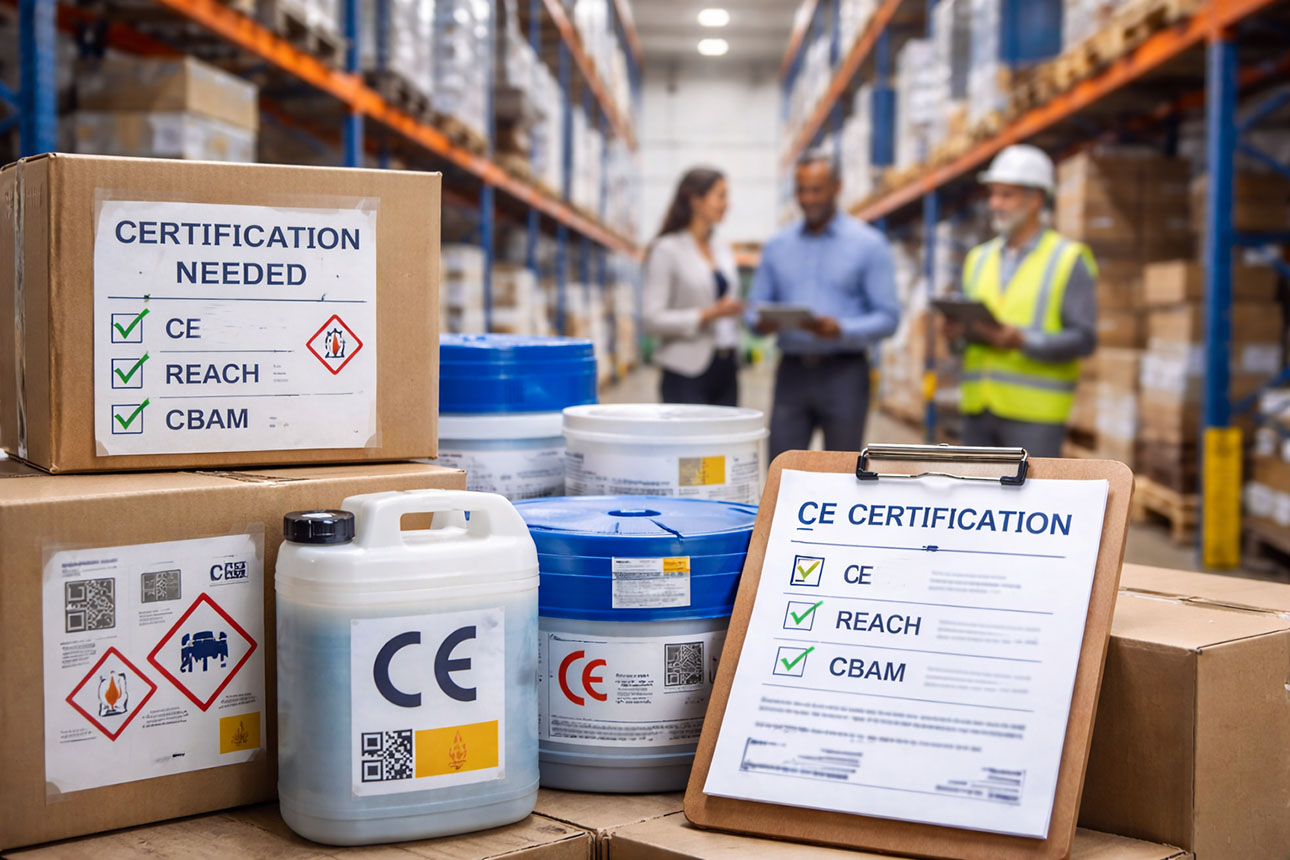
🏷️ Product Labelling and CE Certification for Non-EU Exporters
Even when products are technically compliant, labelling is often where things go wrong first.
Success in CE certification for non-EU exporters often hinges on details like labelling. EU product labelling is not about design preferences or branding. It is a legal requirement that must be aligned with the applicable regulation, the technical file and the Declaration of Conformity. Language requirements, safety warnings, symbols and traceability information are all part of compliance, not marketing.
In practice, many products are stopped or challenged not because they fail tests, but because the labelling does not meet EU requirements. This is particularly common for industrial products, regulated consumer goods and chemicals.
Regulatory reference:
🔗 EU product safety and labelling rules – Your Europe Portal (European Commission)
For real-world implications of incorrect sequencing between labelling and structure, see:
🔗 Export or Market Entry in Turkey: Certification & Compliance Guide
🧪 Beyond CE: REACH Compliance for Exporters
For companies dealing with chemicals, coatings, fertilisers, industrial materials or chemical components, CE marking alone is rarely sufficient.
In practice, REACH and CBAM form a single compliance framework alongside CE certification for non-EU exporters operating in regulated sectors.
REACH and CLP regulations introduce a separate and highly complex compliance framework. This includes substance registration or exemption analysis, Safety Data Sheets, hazard classification and the correct definition of legal roles within the supply chain.
A frequent and costly mistake is assuming that compliance in the country of origin automatically applies to the EU. It does not. REACH obligations depend on volume, substance type and the role a company plays in the supply chain.
Authoritative source:
🔗 REACH obligations explained by European Chemicals Agency
🔄 EAC to CE: Why Transitioning is Complex
Companies exporting from CIS or EAEU markets often ask whether existing EAC certificates can be converted into CE certification.
The honest answer is no. EAC and CE systems are based on different legal principles. While CE certification for non-EU exporters may utilize some existing test data, conformity routes, documentation structure and legal accountability must usually be reassessed from scratch.
Treating EAC and CE as equivalent systems almost always results in delays, duplicated costs and unexpected corrective actions once products reach the EU border.
🌍 CBAM Impact on EU Market Access
With the introduction of the Carbon Border Adjustment Mechanism (CBAM), EU compliance is no longer limited to product safety and documentation.
Ignoring the connection between CBAM and CE certification for non-EU exporters leads to delayed clearance and blocked shipments. For specific product categories, exporters must now deal with emissions reporting, supply chain data collection and future cost implications that directly affect pricing and competitiveness.
Official EU reference:
🔗 Carbon Border Adjustment Mechanism (CBAM) – European Commission
⚠️ The Real Risks of Non-Compliance
Non-compliance in the EU rarely starts with fines. More often, it starts with blocked customs clearance, delayed deliveries, contract disputes with distributors or a sudden loss of trust from European partners.
In many cases, fixing compliance issues after market entry costs significantly more than addressing them correctly from the beginning. The damage is not only financial, but reputational.
🧭 Why Advisory Matters More Than “Fast Certification”
The EU compliance system is not designed for shortcuts.
Promises such as “CE certification in a few days” often hide unnecessary testing, incorrect conformity routes or documentation that does not withstand inspection. Proper compliance advisory focuses on understanding what is legally required, avoiding redundant costs and building a defensible compliance roadmap aligned with the business model.
Related internal service:
🔗 EU Certification & Compliance Consulting Services
🤝 From Advisory to Execution
My role is to help companies understand the regulatory landscape, identify risks early and make informed decisions before entering the EU market.
Operational execution including structured certification processes, documentation and coordination with testing bodies is delivered by Inspira Business, ensuring that regulatory strategy is translated into compliant, market-ready results.
For broader strategic context and related insights, visit:
🔗 Business & Market Entry Insights Blog
🚀 Next Step
If you are planning to export to the EU or are already facing compliance challenges, the first step is clarity — not certificates.
Frequently Asked Questions on CE Certification for Non-EU Exporters
Is CE certification mandatory before exporting products to the EU?
Yes. CE certification for non-EU exporters is mandatory for all products covered by EU harmonised legislation before they are placed on the EU market.
Without a valid CE marking and the required technical documentation, products can be blocked at customs, withdrawn from the market or rejected by distributors and online marketplaces.
However, CE certification must be aligned with the exporter’s legal role (manufacturer, importer or authorised representative). Certifying without defining this structure often leads to unusable or incomplete compliance.
Can EAC certificates be reused or converted into CE certification?
No. EAC and CE certification systems are not transferable.
They are based on different legal frameworks, conformity assessment routes and liability models.
While some test results may technically support CE certification, a new EU conformity assessment is always required. Assuming that EAC certification is sufficient for EU market access is one of the most common causes of delays and rejected shipments for exporters from CIS and EAEU markets.
When do REACH and CBAM obligations apply to non-EU exporters?
Before exporting, not after.
For many regulated products, REACH and CBAM apply alongside CE certification, forming a single compliance framework for non-EU exporters.
REACH obligations depend on substance type, volume and supply-chain role, while CBAM introduces emissions reporting and future cost exposure for specific product categories. Addressing these requirements only after goods are produced or shipped often results in blocked imports and unexpected costs.