


Manufacturing Relocation to the Western Balkans in 2026
Manufacturing relocation in the Balkans is best understood as a nearshoring decision, not a generic low-cost move. Serbia, North Macedonia, Bosnia and Herzegovina and Montenegro have different industrial structures, incentive systems, labour markets and trade arrangements. The right location depends on the product, required capacity, target market and the level of local investment.
For European manufacturers, the region can be attractive because of geographic proximity, established industrial clusters and preferential trade frameworks. But there is no single “Balkans package”: an automotive component project in Serbia, a TIDZ investment in North Macedonia and a metal-processing operation in Bosnia need different legal, financial and supply-chain models.
Start with the product, not a country ranking
The first screen should define volumes, process steps, tolerance and quality requirements, machinery, certifications, energy use, labour skills, inbound materials, outbound markets and the origin rule relevant to the finished product. Only then should locations be scored.
For the broader methodology and a comparison with Türkiye, see Manufacturing Relocation Consulting for Turkey & the Balkans.
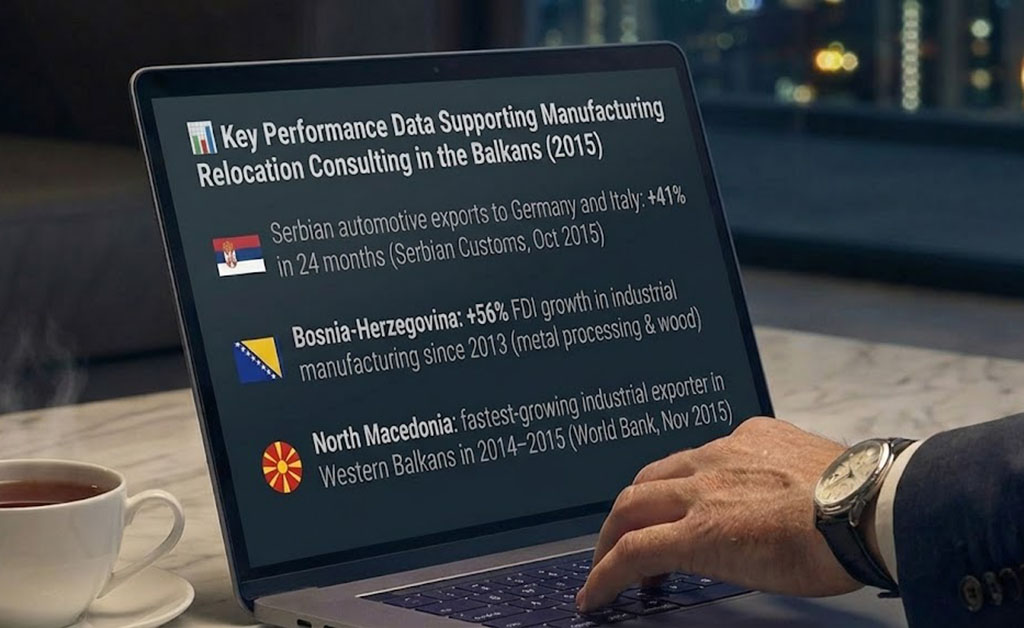
Four different manufacturing propositions
Serbia: the broadest industrial base
Serbia is usually the first Western Balkan market I test for projects that require a broad supplier base, established industrial locations and access to larger-scale manufacturing. The Development Agency of Serbia confirms that qualifying greenfield and brownfield manufacturing investments can access cash-grant programmes under the country’s investment legislation. Eligibility, investment size, employment and project conditions must be checked before the grant is included in a business case.
North Macedonia: TIDZ-led investment structure
North Macedonia can be particularly relevant when a project fits the Technology Industrial Development Zone framework. The official TIDZ authority describes support that can include up to a ten-year profit-tax and personal-income-tax holiday and state aid up to defined limits of eligible investment costs. These are conditional investment measures, not automatic benefits for every manufacturer.
Bosnia and Herzegovina: strong niches, jurisdiction-specific rules
Bosnia and Herzegovina can be competitive in metal processing, wood/furniture, components and other established manufacturing niches. The Foreign Investment Promotion Agency lists customs relief for defined investment equipment and other investor benefits, but tax and incentive rules vary by entity and, in some cases, by lower level of government. The exact location therefore matters as much as the national headline.
Montenegro: smaller ecosystem, selective fit
Montenegro has a smaller manufacturing base than Serbia or Bosnia and Herzegovina. It can still fit selected projects where logistics, a specific supplier or investment location creates a clear advantage, but it should not be treated as a substitute for a deeper industrial ecosystem without confirming local capacity.
| Location | Typical reason to evaluate it | What must be verified |
|---|---|---|
| Serbia | Broad industrial base, supplier depth, greenfield/brownfield investment options | Grant eligibility, labour availability, origin rule, logistics and supplier capacity |
| North Macedonia | TIDZ structure, export-oriented industrial investment | State-aid eligibility, zone agreement, skills, logistics and product-specific origin |
| Bosnia and Herzegovina | Competitive manufacturing niches and selected equipment/investment relief | Entity/canton rules, supplier depth, customs procedure and infrastructure |
| Montenegro | Selective smaller-footprint projects | Local capacity, workforce, supplier redundancy and transport economics |
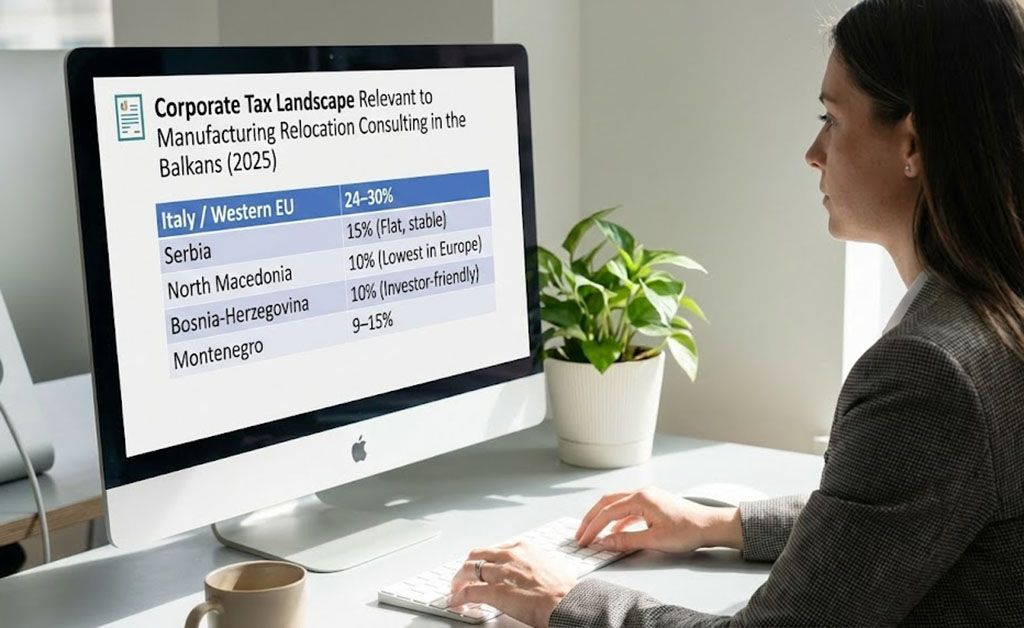
The comparison should be built from quotations, payroll assumptions, freight routes, tooling, utilities, quality costs and the applicable tax/incentive rules for the exact location. A headline tax rate or wage number is not enough to choose a production base.
Incentives and origin: two areas where shortcuts create expensive errors
Investment incentives can improve a viable project, but each programme has eligibility conditions. Serbia’s cash grants, North Macedonia’s TIDZ measures and Bosnia and Herzegovina’s investment-equipment relief should be verified with the competent authority before they are included in the financial model.
Preferential origin is equally project-specific. The Western Balkan partners participate in the Pan-Euro-Mediterranean origin system, and the revised PEM Convention is the relevant framework in 2026. A product must satisfy the applicable product-specific origin rule. EUR.1 or EUR-MED is a proof of origin used when those requirements are met; neither document creates origin by itself, and there is no universal rule that “50% local value” automatically makes every product duty-free.
The European Commission publishes the relevant preferential-origin framework and arrangements for Serbia, North Macedonia, Bosnia and Herzegovina and Montenegro. Origin should be checked at HS-code level before deciding which processing steps to relocate.
Official references: Development Agency of Serbia, North Macedonia TIDZ, FIPA Bosnia and Herzegovina and European Commission – Preferential Rules of Origin.
How to compare Western Balkan manufacturing locations
| Decision factor | What to compare |
|---|---|
| Industrial capability | Relevant machinery, quality systems, engineering depth, subcontractors and spare capacity |
| Labour | Role-specific pay, availability, turnover, training and shift structure rather than minimum wage alone |
| Logistics | Real door-to-door routes, border time, freight frequency, inventory and contingency routes |
| Tax & incentives | Project-specific eligibility, duration, compliance obligations and downside case without incentives |
| Origin & customs | HS-code rule of origin, cumulation, proof of origin and import requirements in the destination market |
| Control | Contract manufacturing vs subsidiary/JV, IP, tooling ownership, audit rights and quality escalation |
A controlled relocation sequence
I normally structure a Western Balkans manufacturing project in gates: feasibility and country screen; factory/supplier shortlist; commercial and technical due diligence; site visits; sample or pilot production; origin and compliance validation; contract and quality plan; and controlled ramp-up. A focused validation can often be organized around a 90–180 day planning horizon, but full implementation varies widely with machinery, construction, certification, tooling and product complexity.
The aim is to create evidence before committing scale. If a supplier cannot demonstrate capacity, quality control and corrective-action discipline during the pilot stage, the project should not progress simply because its quotation is attractive.
Where the cluster fits in your wider expansion plan
For company establishment and local operating structure, see Start a Business in Serbia & the Balkans. For the broader regional commercial strategy, see Turkey & Balkans Business Expansion Strategy. For customer, partner and market-entry work beyond production, see International Market Expansion Consulting.
If you are comparing factories, suppliers or investment locations in the Western Balkans, I can help build the shortlist, test the business case and coordinate due diligence before the relocation decision becomes irreversible.
Frequently Asked Questions About Manufacturing Relocation in the Balkans
Why evaluate the Western Balkans for manufacturing relocation?
The region can combine proximity to EU markets with established industrial capabilities and investment frameworks. The value proposition differs by country: Serbia offers the broadest industrial base, North Macedonia has a TIDZ-led investment model, Bosnia and Herzegovina has strong manufacturing niches, and Montenegro is a more selective fit.
How long does a Western Balkans manufacturing relocation project take?
There is no standard six-month guarantee. Supplier validation and pilot production may be organized within a 90–180 day planning horizon in suitable cases, while asset-heavy projects, machinery moves, permits, construction or certification can require much longer.
Can Western Balkans production obtain preferential access to the EU or other PEM markets?
Potentially, but only when the finished product satisfies the applicable product-specific preferential origin rule. EUR.1 or EUR-MED can be used as proof of origin where the legal conditions are met; they do not automatically create origin, and there is no universal 50% local-value rule.